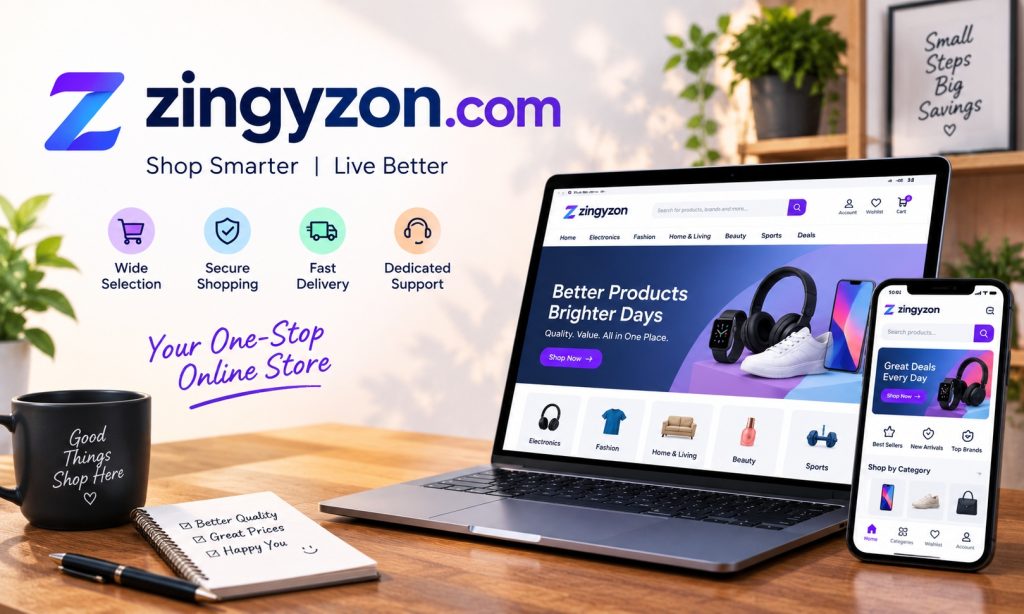
If you landed on zingyzon.com through an Instagram ad, a Facebook post, or a random Google search and you’re wondering whether it’s safe to order from, you’re asking the right question before, not after, you enter your card number. This article won’t tell you zingyzon.com is a scam or that it’s trustworthy, because I don’t have verified information either way. What I can give you is a practical way to check it yourself in under ten minutes, using the same signals that fraud investigators and consumer protection sites rely on.
New e-commerce domains pop up constantly, many of them running the same playbook: low prices, aggressive ad spend, and a storefront that looks polished but has almost nothing behind it. Some of these sites are perfectly fine, just small operations trying to get off the ground. Others exist purely to take your payment info and disappear. The difference usually shows up in details most shoppers never think to look for.
Table of Contents
ToggleStart With the Domain Itself
Every website has a registration date, and you can pull it up for free using a WHOIS lookup tool like whois.com or ICANN’s lookup service. Type in zingyzon.com and check when the domain was created.
Here’s the rule of thumb: a domain registered within the last few months, paired with a huge product catalog and “50% off everything” banners, is a warning sign. Legitimate retailers build up an online presence over years. A store that’s six weeks old but claims thousands of five-star reviews is worth a second look. Also check who registered it. If the registrant info is hidden behind a privacy proxy service based in a country that doesn’t match the store’s claimed location (say, the site says “USA-based” but the registration traces to Southeast Asia or Eastern Europe), that’s inconsistent enough to matter.
Look for a Real Address and a Working Phone Number
Scroll to the footer or the “Contact Us” page. A legitimate business almost always lists a physical address you can verify on Google Maps, and a phone number that actually connects to a human when you call it.
A lot of questionable stores either skip this entirely or list an address that turns out to be a random warehouse, an empty lot, or a residential building with no connection to retail. If zingyzon.com only offers a contact form or a Gmail address and nothing else, treat that as a meaningful gap, not a minor inconvenience.
Reverse-Search the Product Photos
This one catches more fake stores than almost anything else. Right-click a few product images on the site (or screenshot them) and run them through Google’s reverse image search or TinEye.
If the exact same photos show up on AliExpress, Temu, or a dozen unrelated storefronts with different brand names slapped on, you’re looking at dropshipped inventory being resold under a manufactured brand identity. That’s not automatically a scam, some dropshippers do fulfill orders honestly, but it does mean the “exclusive collection” language on the site is fiction, and it strips away any assurance about quality control or shipping timelines.
Read the Return Policy Like a Contract, Not Marketing Copy
Most fake stores publish a return policy that sounds generous on the surface (“100% satisfaction guaranteed!”) but is written to be functionally impossible to use. Watch for phrases like a 14-day return window that starts from the order date rather than the delivery date, since international shipping alone can eat up two or three weeks. Watch for language requiring the customer to pay return shipping to an overseas address, or a restocking fee that eats most of the refund anyway.
If you can’t find a return policy at all, or the page is a generic template that doesn’t even reference the store’s own name correctly, that’s often a copy-pasted page nobody bothered to customize, which tells you something about how much thought went into the rest of the operation.
Check Independent Review Platforms, Not Just the Site’s Own Reviews
Reviews embedded directly on a store’s product pages are close to worthless as evidence, since the store controls what gets published. Instead, search the domain name directly on Trustpilot, the Better Business Bureau, Reddit, and Scamadviser.
A pattern worth taking seriously: a cluster of one-star reviews describing orders that never arrived, customer service that goes silent after payment, or unexpected recurring charges on a card that was only supposed to be billed once. If you see several reviews independently describing the same specific problem (not just “bad quality,” but something concrete like “charged twice” or “tracking number doesn’t exist”), that’s a stronger signal than a single angry review might be.
Pay With a Credit Card, Never a Direct Bank Transfer
This applies whether or not zingyzon.com turns out to be legitimate. Credit cards give you chargeback rights if a merchant doesn’t deliver or turns out to be fraudulent. Debit cards offer weaker protection, and bank transfers or cryptocurrency payments offer essentially none. If a store pushes you toward an unusual payment method or offers a discount for paying that way, that’s a direct incentive to avoid the payment method that would protect you, and it should raise your guard immediately.
What a Legitimate Small Store Actually Looks Like
Not every unfamiliar site is a scam. Plenty of small, honest retailers start with a lean website, a modest product catalog, and marketing that leans on paid social ads because they haven’t built organic traffic yet. The difference is usually consistency: a real address that checks out, a phone number that connects, a return policy that’s specific and reasonable, and product photos that at least look like they were taken by the seller rather than lifted wholesale from a marketplace listing. None of these checks take more than a few minutes individually, but running all of them together gives you a much clearer picture than any single one on its own.
Frequently Asked Questions
Is zingyzon.com a scam?
There’s no independently verified information confirming that one way or the other at this time. The checks above (domain age, contact info, reverse image search, independent reviews) are how you can evaluate it yourself before ordering.
What should I do if I already ordered and paid?
Contact your card issuer immediately if the order doesn’t arrive within the stated window or the item is significantly different from what was advertised. Most banks allow chargeback disputes within 60 to 120 days of the transaction, but the exact window varies by issuer.
Why do these new online stores keep appearing?
Setting up an e-commerce storefront is cheap and fast using platforms like Shopify, and dropshipping suppliers make it possible to run a “store” without holding any inventory. That low barrier to entry is why new domains, legitimate and fraudulent alike, show up constantly.
Is a cheap price by itself a red flag?
Not on its own. Combine it with the other checks. A steep discount paired with a brand-new domain, no verifiable address, and stock product photos is a much stronger warning than a low price alone.
Before you place an order anywhere unfamiliar, run the domain through a WHOIS lookup and a reverse image search on two or three product photos. Those two checks alone take less than five minutes and catch the majority of fake storefronts before your card ever gets charged.