
Here is a curious fact about one of America’s best-loved songwriters: he has not released a new pop album of original songs since 1993, yet he is still counted among the wealthiest musicians alive. No new records, no streaming-era marketing push, and still the money kept arriving.
So how does that work? And is the figure you keep seeing online actually reliable?
This guide breaks down the commonly cited Billy Joel net worth, the income streams behind it, the business lessons buried in his career, and the questions fans ask most. You will also see where the estimates are solid and where they are educated guesses.
Table of Contents
ToggleThe Short Answer: How Much Is Billy Joel Worth?
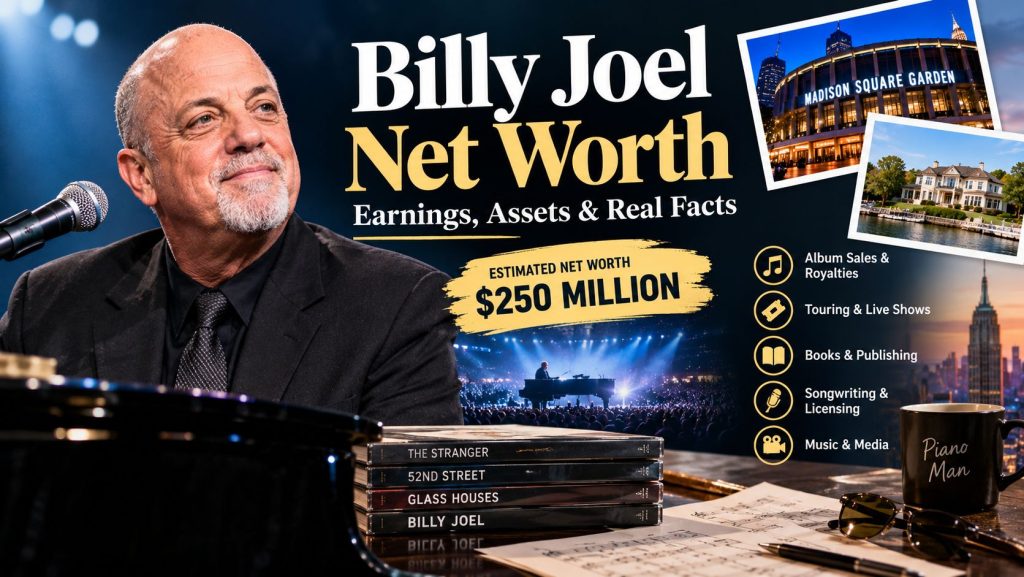
Billy Joel’s net worth is estimated at roughly $250 million. Celebrity Net Worth lists that figure and notes he has sold over 160 million records worldwide. Other sites land close by, though not identically. One analysis describes a range of $250 million to $300 million, while another puts it near $225 million.
Treat these as informed estimates. Joel has never published a personal balance sheet, and no outside source can see his debts, investments, or private holdings. A few sites float much higher or lower numbers, but those tend to be outliers without clear sourcing.
Quick facts at a glance
- Full name: William Martin Joel
- Born: 1949, raised in Hicksville, New York
- Known for: “Piano Man,” “Just the Way You Are,” “Uptown Girl,” “We Didn’t Start the Fire”
- Estimated net worth: about $225 million to $300 million, most often quoted at $250 million
- Main income sources: album sales and royalties, touring, songwriting and publishing, and his long Madison Square Garden run
Where the Money Really Comes From
A big number is fun. Understanding where it came from is more useful. Joel’s fortune rests on a few pillars that built on each other across five decades.
Record Sales and Catalog Royalties
Joel’s biggest wealth engine is the catalog itself. He wrote or co-wrote most of the songs he performs, which matters enormously. A songwriter earns money not just when an album sells, but every time a song is played on the radio, streamed, licensed for a film or ad, or covered by another artist.
Hits like “Piano Man,” “Only the Good Die Young,” “Movin’ Out,” and “She’s Always a Woman” have stayed in constant circulation for decades. Songs that endure behave like rental properties: they keep paying long after the work was done. In 1985, he released Greatest Hits Vol. I & II, a compilation that became one of the best-selling releases of his career.
Touring and Live Shows
For many artists, live performance eventually overtakes record sales as the main source of income. Joel is a clear example. Between June 2017 and June 2018 alone, he reportedly earned $45 million. That kind of annual figure comes overwhelmingly from ticket sales, merchandise, and stadium and arena dates rather than new recordings.
The Madison Square Garden Residency
If one thing explains how Joel stayed so profitable without releasing new pop albums, it is his famed Madison Square Garden run in New York City. He performed a monthly residency at the venue for roughly a decade, ending in July 2024.
The numbers are striking. Between the residency’s start in 2014 and the end of 2019, Joel reportedly grossed $150 million from the shows. Gross is not the same as take-home, since production, crew, venue fees, and taxes all come out of that number. Still, a single, predictable venue where fans travel to him is a financial model most touring artists would envy.
Songwriting, Publishing, and Ownership
Joel’s decision to hold onto his songwriting rights is an underrated part of the story. A writer who owns, or co-owns, his publishing can earn far more over time than a performer who only collects a recording fee. Plenty of musicians sell their catalogs for large lump sums. Joel, as far as public reports show, has not sold his. One profile notes his catalog is valued in the hundreds of millions.
The Rough Years: Lawsuits and Financial Setbacks
Joel’s wealth was not a straight line. Like many artists who rose quickly in the 1970s, he trusted the wrong people with his money.
In 1989, he sued his former manager, Frank Weber, for $90 million. The dispute was messy and widely covered at the time. He also sued his accountants and lawyers and reportedly received a settlement of about $8 million.
The takeaway goes beyond celebrity gossip. If you earn through creative work, someone else usually manages parts of your money. Joel’s experience is a reminder that trust needs verification, and that being famous does not protect anyone from poor advice.
What Beginners Can Learn From It
Imagine a young freelance musician getting her first big paycheck. A manager offers to “handle everything.” Joel’s story suggests a better approach: keep a copy of every contract, ask for regular statements, and bring in an independent accountant. It sounds dull, but it protects the thing that earns the money in the first place.
Awards and Cultural Weight That Support the Brand
Money in music tends to follow reputation. Joel has earned multiple Grammy Awards and was inducted into both the Rock and Roll Hall of Fame and the Songwriters Hall of Fame. He also received the Kennedy Center Honors in 2013 and the Library of Congress Gershwin Prize for Popular Song in 2014.
These honors do not directly add dollars to a bank account. But they keep catalogs relevant, keep tickets selling, and make licensing deals easier. A songwriter with that kind of standing can command higher fees and stronger bargaining power than a brand-new act.
Lifestyle, Homes, and Spending
Public information on Joel’s real estate and personal spending is scattered and not always reliable. He has been linked to waterfront homes, and his love of motorcycles is widely known. Beyond that, treat detailed claims with caution.
One financial overview notes that specifics about his investments and assets are not publicly available. That caveat is worth taking seriously. Some pages list exact property values and annual earnings with no documents behind them. If a site gives a precise dollar amount for a private person’s house, ask where that number came from.
Health News and What It Means for His Finances
In recent years, Joel’s health has become part of the conversation. Reports describe a brain disorder affecting vision, hearing, and balance, which led to the cancellation of tour dates through July 2026.
For someone whose income leans on live performance, pausing the road has an obvious effect on annual earnings. It does not, however, erase the long-term value of his catalog. Royalties keep flowing from radio, streaming, and licensing, which is exactly why a songwriter’s rights are often described as the safest part of a musician’s wealth.
Why Billy Joel’s Model Is Worth Studying
You do not need to be a rock star to learn from this. Joel’s financial path holds a few lessons that apply to any creator, whether you write songs, build a following, or sell a skill.
- Own what you create. Rights and royalties outlast any single paycheck.
- Build one reliable stage. The Garden run gave him predictable income without the exhaustion of constant travel.
- Keep your catalog valuable. Songs that stay culturally present keep earning. Quality compounds.
- Protect yourself from bad advisors. His lawsuits are a costly lesson in oversight.
- Do not chase every trend. He built wealth by deepening a fanbase, not by constantly reinventing himself.
If you are interested in the modern version of that last idea, our guide on how creators turn audiences into income shows how today’s artists and personalities build direct relationships with supporters in a way earlier generations never could.
Common Mistakes When Reading Celebrity Net Worth Pages
Net worth articles are among the least careful corners of the internet, so it helps to know the traps.
- Mixing up gross and net. A $150 million gross from a residency is not $150 million in the artist’s pocket.
- Copying old figures. Some pages claim to be “updated for 2026” while quietly repeating numbers from years ago.
- Trusting precise details without sources. Exact property values and annual incomes are often guesses.
- Confusing similar names or fake profiles. A few pages in search results appear to be auto-generated and have little to do with the actual person.
A good rule: if two reputable sources agree within a modest range, that range is probably meaningful. If a page contradicts every other source, be skeptical.
Frequently Asked Questions
What is Billy Joel’s net worth?
Billy Joel’s net worth is generally estimated at about $250 million, with some sources placing it between $225 million and $300 million. The figure is an estimate, as Joel has not released a personal financial statement.
How did Billy Joel make his money?
Mostly through songwriting royalties, album sales, touring, and his long-running Madison Square Garden residency. Owning or sharing in the rights to his songs lets him earn from radio play, streaming, and licensing for decades.
How much did Billy Joel earn from Madison Square Garden?
He reportedly grossed around $150 million from the residency between 2014 and the end of 2019. That is a gross figure before costs, so his personal earnings were lower.
Is Billy Joel richer than Paul McCartney?
No. McCartney’s net worth is commonly placed well above Joel’s, in the high hundreds of millions, mainly due to his Beatles royalties and publishing holdings.
Has Billy Joel sold his music catalog?
Public reports do not indicate that he has. Several well-known artists have sold their catalogs in recent years for large sums, but Joel appears to have kept his songs.
Is Billy Joel still performing?
His touring has been affected by health issues, and reports mention canceled dates through July 2026. For current plans, check official announcements from Joel’s team or the venues.