A cartoonist sketches a dysfunctional yellow family in a lobby while waiting for a meeting. Decades later, those characters are still on television, on lunchboxes, in theme parks, and in the cultural vocabulary of several generations.
That is roughly how the Simpsons origin story goes, and it explains why people keep asking how much Matt Groening is actually worth. The answers online range from $500 million to well over a billion dollars, which is a huge gap for a single person’s wealth.
This guide sorts through those figures, explains where his income plausibly comes from, flags the claims you should ignore, and gives you a simple way to judge any celebrity net worth page.
Table of Contents
ToggleThe Short Answer: How Much Is Matt Groening Worth?
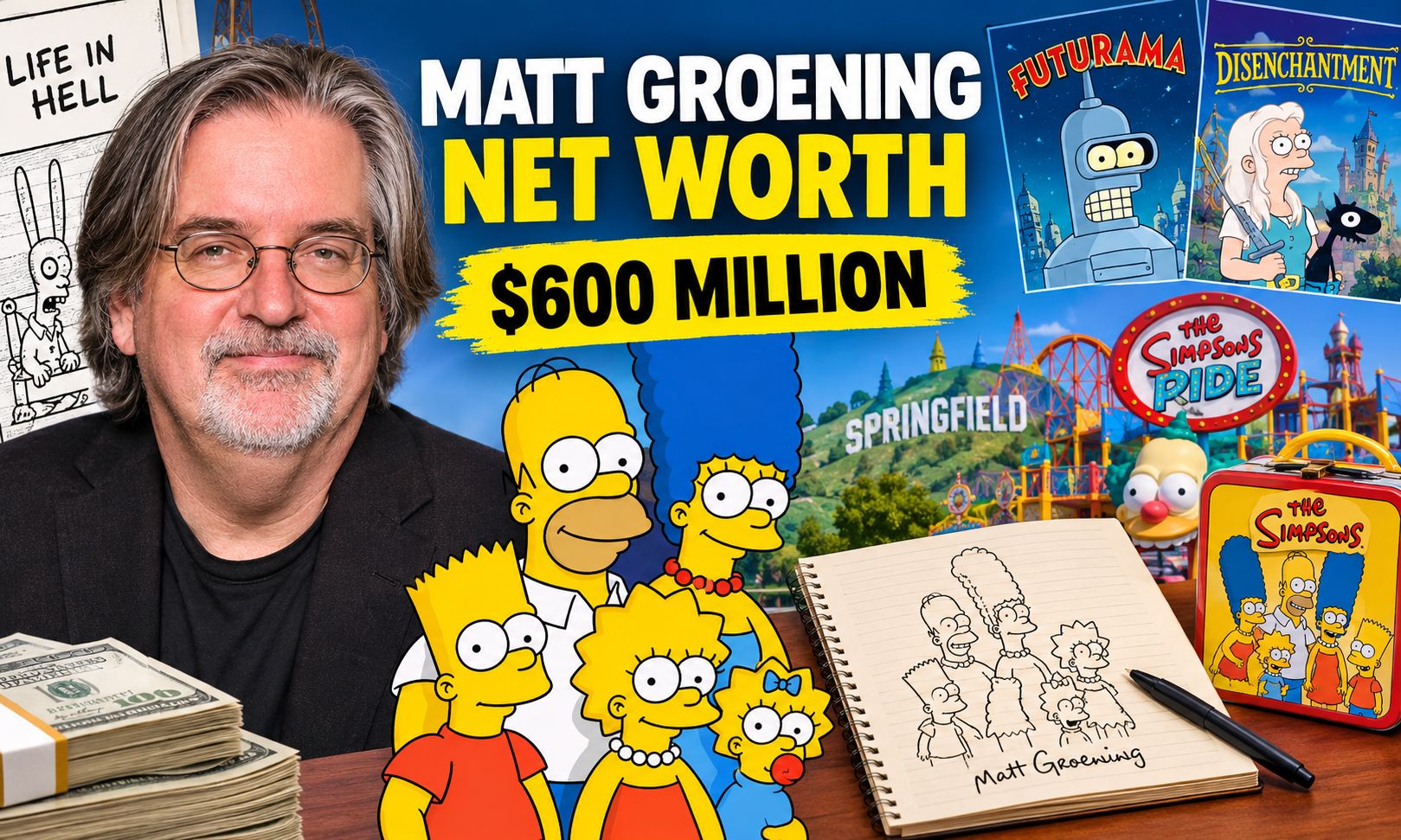
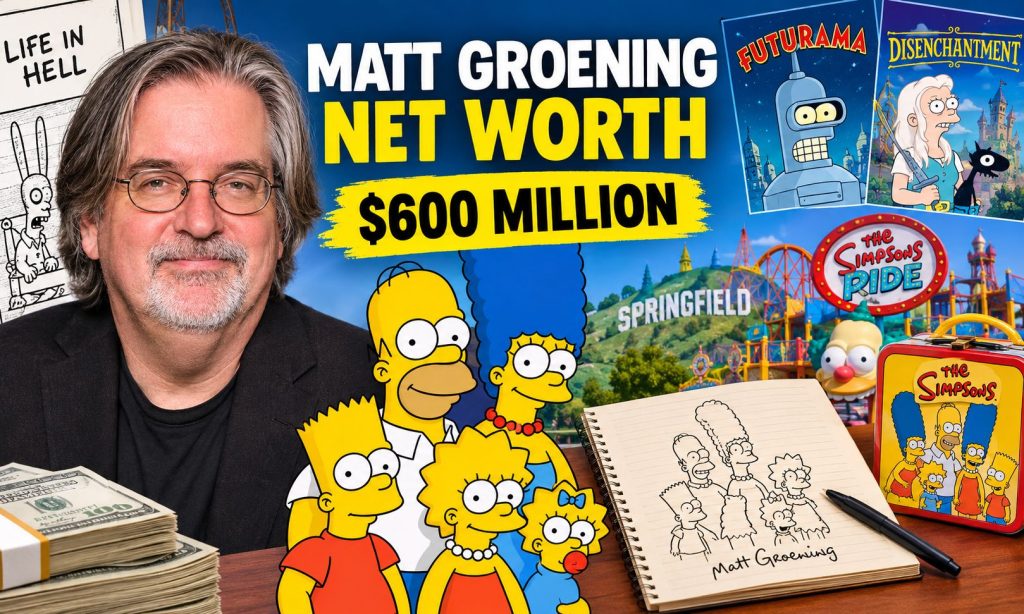
Matt Groening’s net worth is most commonly listed at around $600 million. Published estimates, though, stretch across a wide band:
- About $500 million: One profile estimates his net worth at around $500 million as of 2023.
- About $600 million: Another source states he has amassed a net worth of $600 million.
- About $625 million: A third page, adjusted for inflation, lists $625 million.
- $600 to $800 million: One recent article gives a range of $600 million to $800 million based on net worth outlets and industry analysis.
- $800 million to $1.2 billion: A more aggressive page claims industry estimates place him between $800 million and $1.2 billion.
The most defensible summary is this: his wealth is almost certainly in the hundreds of millions, $600 million is the most-repeated figure, and nobody outside his own financial team knows the true number. Groening has never published a personal balance sheet.
Quick facts
- Born: February 15, 1954, in Portland, Oregon.
- Known for: Creating The Simpsons, Futurama, and Disenchantment, plus the comic strip Life in Hell
- Commonly cited net worth: about $600 million (estimate, unverified)
How a Comic Strip Became the Foundation
Before Springfield, there was Life in Hell. Groening’s early career involved stand-up comedy in the late 1970s alongside odd jobs, and the comic strip gave him a space for counter-culture critique and storytelling.
The strip is more than a footnote. It built his reputation as a sharp, offbeat cartoonist and led directly to the opportunity that changed his life. It also taught him something valuable: having a distinctive voice matters more than having a big platform.
The Meeting That Changed Everything
Groening was invited to pitch ideas for short animated segments for The Tracey Ullman Show. The family he drew for that pitch became the Simpsons. Groening pitched the concept to producer James L. Brooks. The shorts later grew into a half-hour series that debuted in 1989 and became one of the longest-running programs in television history.
Where the Money Really Comes From
Net worth is easier to understand when you break it into streams. For a creator like Groening, a few pillars explain most of the picture.
1. Creator Credit and Residuals on The Simpsons
A creator of a long-running series typically earns income through producer fees, backend participation, and residuals tied to reruns and syndication. One analysis describes the show as a central pillar of his earnings due to extensive syndication and international sales.
The exact deals are private, but the logic is straightforward. A show that has aired for decades keeps generating payments every time it runs, streams, or sells into a new market.
2. Futurama
Futurama added to his reputation as a master storyteller. The series has been canceled and revived more than once, and has run across several periods, including a 2023 return. Each revival creates fresh episode income and boosts interest in the older episodes.
3. Disenchantment and Streaming Work
Groening’s Netflix series Disenchantment contributes through contracts with streaming services. Streaming deals tend to pay upfront fees rather than long backend streams, so they add to income without matching the long-term value of a syndicated hit.
4. Merchandise, Comics, and Licensing
The Simpsons became a merchandising giant, with products ranging from toys to clothing, and the characters have appeared in comics, video games, and theme park attractions. The popularity of these characters has spawned merchandise, movies, and theme park attractions. How much of that revenue reaches Groening personally depends on contract terms that are not public.
Groening also founded Bongo Comics, which published comic books featuring his characters. If you want to see how modern creators build income around loyal audiences, our guide on how creators turn audiences into income covers the same principle at a smaller scale.
Claims You Should Not Trust
This keyword attracts a lot of low-quality pages. Here are the warning signs to watch for.
Invented Income Figures
Some pages state oddly specific numbers with no source. One site claims he earns around $20,000 per episode of The Simpsons, a figure that appears nowhere in verifiable reporting and does not square with how creator deals work.
Fake Authority Quotes
Another page says a Forbes report claims The Simpsons generates $500 million to $1 billion in revenue annually for Groening. That line mixes up show-level revenue and personal income, and it cites a report that cannot be confirmed. Never treat a vague “according to a report” as proof.
Personality Claims
You will also see details about his car, house, or spending habits. One page says he drives a 20-year-old Toyota and lives in a humble home. Without a named source, these are the kind of colorful details that sites add to make a page feel authoritative.
Inflated Future Projections
Several pages claim that revivals add enormous sums to his wealth, such as $50 million or more from the 2023 Futurama revival. A claim like that would require access to contracts that no public source has revealed.
Why His Net Worth Looks Different Everywhere
Four problems explain most of the confusion.
- Contracts are private. Backend participation and ownership shares drive the big numbers, and they are rarely disclosed.
- Revenue is confused with income. A franchise earning billions does not mean its creator earns billions.
- Pages copy each other. A figure repeated across many sites feels established, but it often traces back to one early guess.
- Dates mislead. Some pages are labeled with the current year while repeating old numbers.
A Quick Example
Imagine a TV show that brings in $1 billion in global revenue across merchandise, syndication, and licensing. The studio, distributors, retailers, manufacturers, writers, animators, and executives all take their share. The creator might earn a meaningful percentage, but it would be a fraction of that total. This gap between franchise revenue and personal wealth is the biggest source of exaggerated net worth claims.
What Makes His Position Unusual
Groening’s financial story is not just about talent. It is about longevity.
Few creators see a series run for more than three decades. That staying power means his earnings are not tied to one big payday but to a long, compounding stream of smaller ones. Each season, each rerun, each new streaming agreement adds a little more.
It also shows how valuable owning a creative idea can be. Even sharing in the success of a character-driven franchise can outperform salaries many times over.
Lessons Creators Can Take From His Career
You do not have to create a global franchise to learn from this.
- Start with a distinctive voice. Life in Hell gave him an identity before TV.
- Think long-term. A show that lasts decades builds wealth slowly but steadily.
- Use multiple formats. Comics, TV, streaming, and merchandise all feed one another.
- Protect your characters. Intellectual property is the engine of lasting income.
- Be wary of shortcuts. Groening’s career grew through persistence, not overnight success.
Frequently Asked Questions
What is Matt Groening’s net worth?
Matt Groening’s net worth is most commonly estimated at about $600 million, though some pages list lower or higher figures. None is confirmed by Groening or by public financial records.
How did Matt Groening make his money?
Mainly through creating The Simpsons and Futurama, with income from residuals, syndication, merchandise, licensing, comics, and streaming projects like Disenchantment. The exact breakdown is private.
Is Matt Groening a billionaire?
There is no reliable evidence that he is. A few pages claim estimates above $1 billion, but those pages do not provide verifiable sources.
Does Matt Groening still earn from The Simpsons?
Very likely. Long-running shows generate ongoing income through new episodes, reruns, streaming, and merchandise, though his specific share is not publicly disclosed.
What was Matt Groening’s first big project?
His early comic strip Life in Hell established him as a cartoonist before The Simpsons made him a household name.