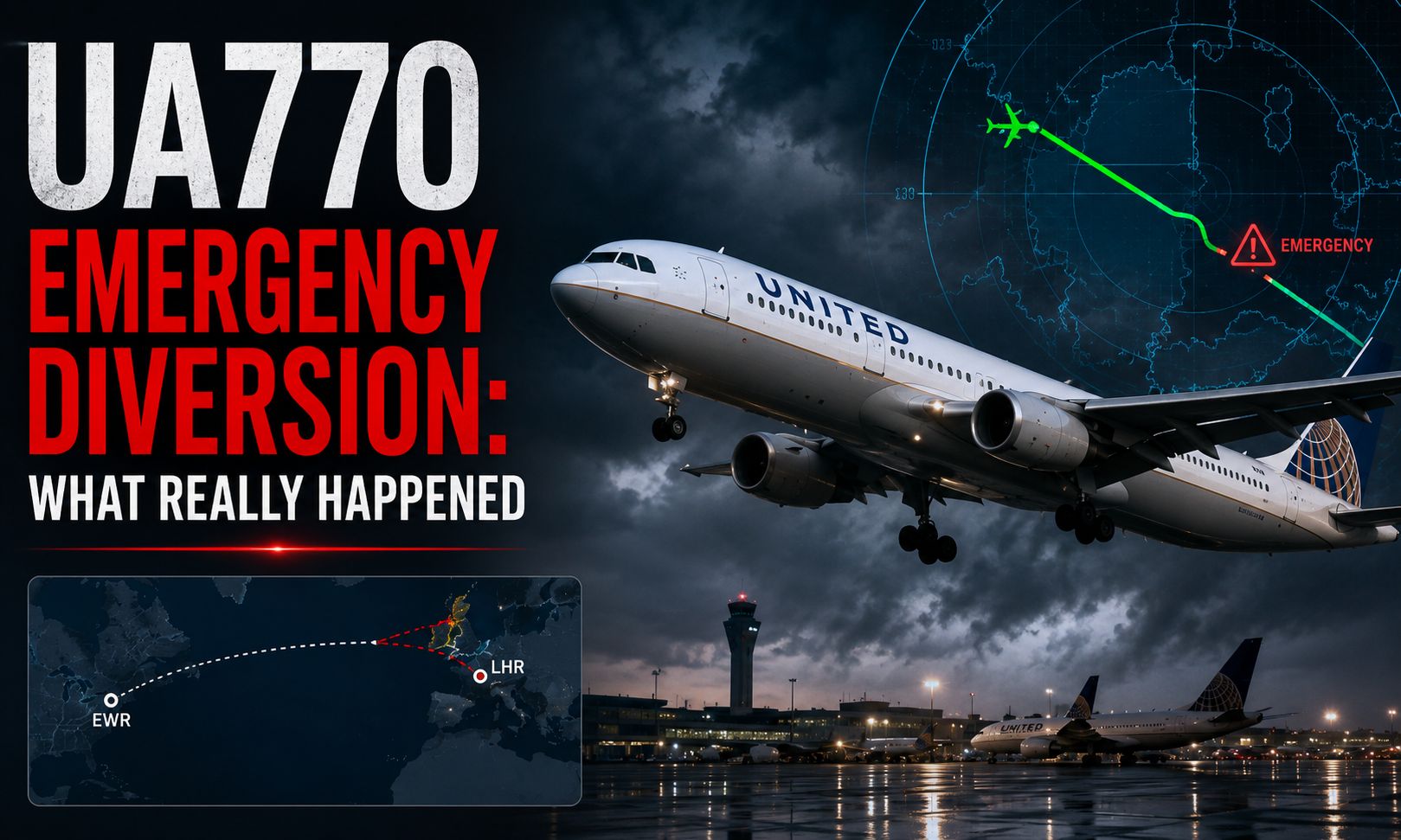
On the morning people settled into their seats aboard a Boeing 787-9 Dreamliner at Barcelona-El Prat Airport, expecting a long but routine transatlantic crossing to Chicago O’Hare. The aircraft pushed back on schedule, climbed smoothly to cruising altitude, and for the first ninety minutes, everything unfolded exactly as planned. Then, somewhere over the North Atlantic, the flight deck received an alert that would change the course of the journey entirely. What followed was not a crisis, but it was a precise, carefully coordinated chain of decisions that brought Flight UA770 safely to the ground at London Heathrow Airport and reminded the world of how quietly and effectively the aviation safety system works.
What the Pressurization Warning Actually Meant
The alert that triggered the diversion was linked to the aircraft’s cabin pressurization system, one of the most critical environmental systems on any commercial aircraft operating at high altitude. At 37,000 feet, the outside air pressure is far too low for human survival without assistance. The pressurization system continuously regulates the air inside the cabin to simulate conditions roughly equivalent to an altitude of 6,000 to 8,000 feet, keeping passengers comfortable and safe throughout the flight.
The warning the crew received did not indicate that cabin pressure had actually been lost. Oxygen masks did not deploy, and passengers did not experience any physical symptoms of pressure change. What the instruments detected was a potential irregularity in one of the environmental control system sensors, a reading that suggested something may not have been functioning as expected within that system. In practice, a sensor anomaly at altitude is not something any crew can dismiss. The absence of visible symptoms does not rule out the possibility of a developing issue, and at that height, there is no margin for uncertainty.
Modern aircraft like the Boeing 787-9 Dreamliner are equipped with layered warning systems precisely because early detection matters. The Dreamliner’s advanced avionics are designed to flag potential issues before they become confirmed failures, giving crews the information and the time to respond appropriately. That is exactly what happened here.
How the Diversion Decision Was Made
Once the crew identified the pressurization irregularity, they followed established in-flight emergency procedure with composure and precision. The first step was declaring a general emergency by setting a squawk 7700 code on the transponder, a universal signal to air traffic control that the aircraft requires priority handling. From that point, the situation became a coordinated effort between the cockpit, the airline’s operations team, and controllers across multiple airspace regions.
Choosing a diversion airport involves several simultaneous considerations: the aircraft’s current position, remaining fuel, weather conditions at potential alternates, runway length, available ground support, and the specific nature of the issue on board. London Heathrow emerged as the clear choice. It was within a manageable distance of their North Atlantic position, it operates as one of the world’s most capable hubs for handling wide-body aircraft emergencies, and it has the maintenance infrastructure and engineering resources to properly assess a pressurization system concern.
European air traffic control centers, coordinated through EUROCONTROL, managed UA770’s passage through Spanish, French, and British airspace seamlessly. Priority routing was granted immediately, other traffic was cleared, and the aircraft began a controlled descent toward the United Kingdom without delay. The entire coordination chain, from emergency declaration to approach clearance, reflected the kind of international aviation cooperation that rarely makes headlines but keeps air travel as safe as it is.
The Landing and Ground Response at Heathrow
Flight UA770 touched down on Runway 27R at London Heathrow at approximately 4:55 PM BST. Emergency response vehicles were positioned along the taxiway as a precautionary measure, standard practice whenever an aircraft arrives under an emergency declaration regardless of whether the situation is confirmed critical. The aircraft was guided to Gate B44, where a team of ground engineers was already in position to begin technical inspections and coordinate passenger assistance.
What happens after an emergency diversion is often as logistically complex as the diversion itself. Engineering teams need to conduct thorough inspections of the affected system before the aircraft can be cleared to continue any further service. At the same time, the airline’s ground operations team moves quickly to identify accommodation, arrange transport, communicate with connecting flight operators, and begin the rebooking process for over 250 passengers who were now several hundred miles from their intended destination.
Passengers disembarked calmly and were directed to the terminal, where United Airlines personnel began coordinating the ground support operation. No injuries were reported, and all 257 passengers and 12 crew members were accounted for.
What Passengers Experienced on Board
For the people sitting in the cabin during the diversion, the experience was naturally unsettling at first. The aircraft changed course without warning, the descent began earlier than expected, and it was clear something had changed. What prevented anxiety from turning into panic was the professionalism of the cabin crew.
Flight attendants moved through the cabin calmly, providing clear and measured information about the situation. Passengers later reported that the crew communicated confidently, maintained a composed presence, and ensured that everyone understood what was happening without causing unnecessary alarm. The landing itself was described as smooth and uneventful, with no indication during the actual touchdown that anything had been out of the ordinary.
Aviation experts consistently point to crew communication as one of the most important factors in passenger wellbeing during irregular operations. When cabin crew convey calm and control, passengers reflect that energy. The response on UA770 is a strong example of that dynamic working as intended.
Why a Diversion Like This Is Proof of Safety, Not Failure
There is a tendency, when reading about an airline emergency diversion, to interpret the word “emergency” as evidence that something went seriously wrong. In the case of UA770 Barcelona to Chicago diversion, the opposite reading is the more accurate one.
Modern commercial aviation is built on a principle of conservative decision-making. Pilots are trained to treat an unconfirmed warning with the same seriousness as a confirmed failure, because the cost of underreacting at altitude is far greater than the cost of a precautionary diversion. The aviation safety culture that drives this mindset did not emerge by accident. It was built through decades of study, incident analysis, and the development of standardized procedures that remove ambiguity from high-pressure decisions.
The Boeing 787-9 Dreamliner’s advanced sensor architecture detected a potential concern early enough for the crew to respond with time and options available. Air traffic control provided immediate priority. The airline’s ground teams were ready before the aircraft arrived. Every layer of the system performed its function. That is not a near-miss. That is aviation safety working at its best.
Passenger Rights Following an Emergency Diversion
For travelers who found themselves unexpectedly in London with no clear timeline for the next leg of their journey, understanding their rights is important. When a flight diversion results in a significant delay, airlines are obligated to provide a defined level of passenger care.
Passengers affected by diversions are generally entitled to the following:
- Meals and refreshments during waiting periods exceeding three hours
- Hotel accommodation if an overnight stay is required as a result of the delay
- Transport between the diversion airport and any provided accommodation
- Access to communication, including telephone calls or emails to notify family or travel contacts
- Automatic rebooking on the next available flight to the original destination at no additional cost
- The option to cancel the journey entirely and receive a full refund if the delay exceeds a threshold that makes continued travel impractical
Passengers should retain all receipts for any out-of-pocket expenses incurred during the delay period, as these may be submitted for reimbursement. United Airlines, as the operating carrier, carries the responsibility for communicating passengers’ entitlements clearly and facilitating the claim process.
Visit My Website: 5ivemagazine
A Broader Reflection on What This Event Means
The UA770 Barcelona to Chicago diversion, with its carefully managed response and safe outcome for everyone on board, is a reminder that the aviation safety system functions at its most effective when it is least visible. No dramatic failure occurred. No one was hurt. The protocols that have been refined over decades of commercial aviation simply activated, and the result was a controlled, professional response that protected 269 lives.
The pilots who made the diversion call, the air traffic controllers who cleared the route, the cabin crew who kept the atmosphere calm, the engineers waiting at the gate, and the ground staff managing logistics all played their part. 5ive Magazine recognizes that events like this rarely receive the kind of attention that reflects their true significance. They deserve it. An emergency diversion is not a story about what went wrong. It is a story about what aviation does right.