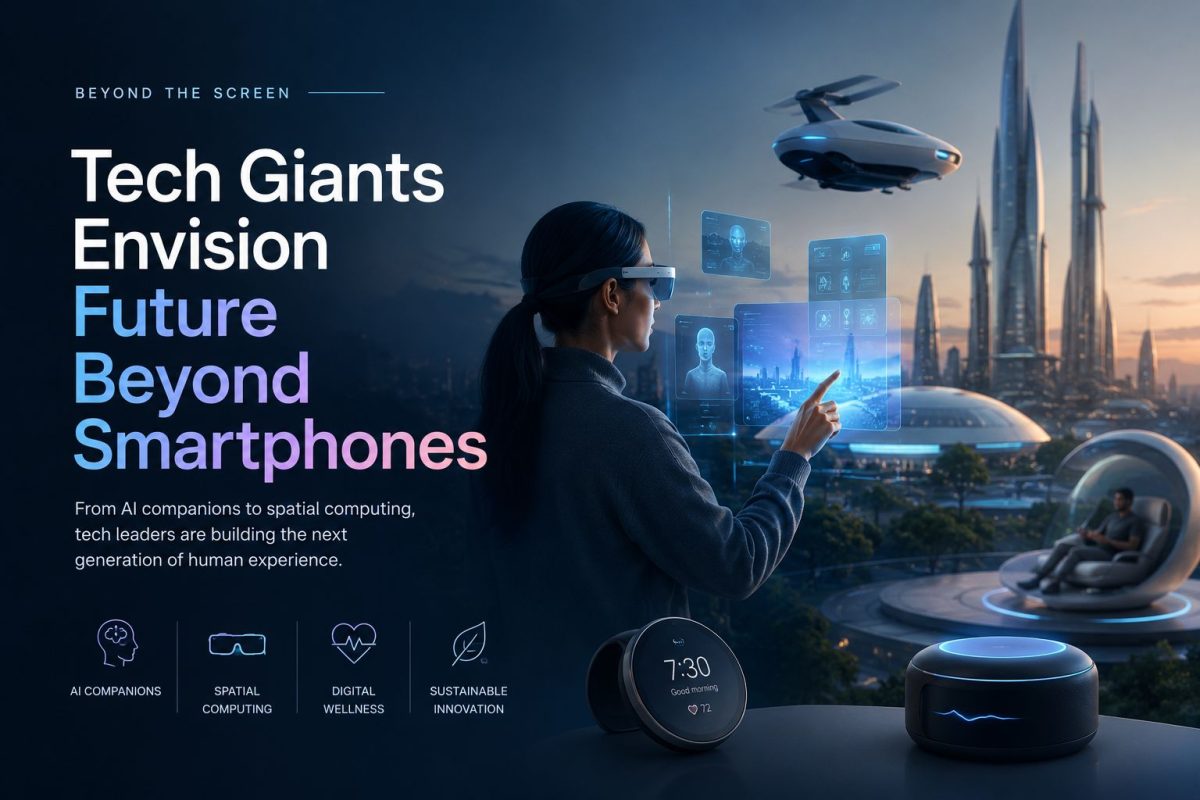
For nearly two decades, the smartphone has sat at the center of modern life. It wakes us up, guides us through cities, connects us to the people we love, and keeps us plugged into work. It has become, in many ways, an extension of the human hand. But something is shifting. The world’s most powerful technology companies are no longer competing over who can make the best smartphone. They are competing over what replaces it.
This is not a distant forecast. The race to build a post-smartphone world is already well underway, and the investments pouring into it are unlike anything the consumer tech industry has seen in a generation. As tech giants envision a future beyond smartphones, the question for the rest of us is not whether this shift will happen, but how it will change the way we live and work.
Table of Contents
ToggleWhy the Smartphone Era Is Starting to Show Its Age
The smartphone was, by any measure, a remarkable invention. When it arrived in its modern form in the late 2000s, it condensed an entire computing infrastructure into something that fit in a shirt pocket. It changed communication, commerce, media, and navigation in ways that still feel profound. But after years of incremental updates, the category is maturing.
Screen sizes have stabilised. Processing improvements are becoming less noticeable in daily use. Camera upgrades, while impressive, are no longer the revolutionary leaps they once were. And beyond the hardware, there is a growing cultural awareness that the smartphone, for all it enables, also takes something away. Constant notifications, fragmented attention, and the social habit of looking at a screen instead of a room full of people have created a kind of quiet exhaustion around these devices.
This fatigue has not gone unnoticed by the companies building the next chapter of personal technology. They see both an opportunity and a responsibility to move beyond the screen.
Augmented Reality Glasses and the New Interface Layer
Of all the technologies being positioned as successors to the smartphone, augmented reality glasses have generated the most serious investment and the most credible product roadmaps. The premise is straightforward: rather than pulling a phone from your pocket to check a message, get directions, or identify something in front of you, the information appears in your field of view, layered gently over the physical world.
Meta has been among the most aggressive in this space. Its Ray-Ban smart glasses, developed in partnership with EssilorLuxottica, have seen significant commercial traction, with sales tripling in the first half of 2025. The company’s roadmap extends well beyond audio-focused wearables to fully integrated display glasses, with a prototype called Orion described internally as among the most technically advanced AR systems ever built. Mark Zuckerberg has spoken openly about wanting to put AI glasses into the hands of hundreds of millions of people.
Google is re-entering the space with a structured three-tier strategy through its Android XR platform, beginning with lightweight audio-first glasses in 2026 and working toward display-capable devices that leverage a connected phone as a processing engine. This approach keeps the hardware light while tapping into the power consumers already carry.
Apple, characteristically, has been quieter but no less active. Reports indicate the company is testing multiple frame designs for AI-enabled smart glasses, with a display-free model expected first. Deep integration with Apple Intelligence and its broader software ecosystem would give Apple a distinctive advantage in terms of seamless user experience.
What has changed from earlier, failed attempts at smart glasses is the quality of the underlying artificial intelligence. Google Glass struggled in 2013 partly because the software was not capable enough to justify wearing a computer on your face. Today’s AI systems can understand natural language in real time, recognise objects in a live camera feed, maintain context across extended conversations, and anticipate what a user needs before they ask for it. That is a fundamentally different capability set, and it transforms the glasses from a novelty into something with genuine daily utility.
Ambient Computing and the Invisible Interface
The broader concept underpinning all of this work is ambient computing, a term that describes technology that fades into the background of life rather than demanding your attention. Instead of opening an app, searching for information, and staring at a screen, ambient computing delivers what you need in the moment you need it, through voice, gesture, context, or even a glance.
This vision involves more than just glasses. Smart rings, AI-powered earbuds, voice assistants with memory and reasoning capabilities, and spatial audio systems all form part of an interconnected wearable ecosystem. These devices communicate with each other and with cloud-based AI to build a picture of what a person is doing, where they are, and what they are likely to need next.
The appeal of this kind of technology is not just convenience. It is the possibility of engaging with the digital world without being pulled out of the physical one. A user walking through a city could receive spoken directions without ever looking at a screen. A professional in a meeting could quietly receive relevant context notes without disrupting the conversation. A parent cooking dinner could get step-by-step guidance through an earpiece while keeping their hands free.
Brain-Computer Interfaces and the Longer Horizon
While augmented reality represents the near-term frontier, companies working on brain-computer interface technology are looking further ahead. The idea that digital interaction could one day bypass physical input entirely and operate through thought-based commands sounds like science fiction, but laboratory demonstrations of this capability are no longer theoretical.
Neuralink, among others, has moved from research into human trials. The promise of BCIs is not primarily aimed at replacing smartphones in everyday consumer use in the short term, but at creating new interaction paradigms for people with physical limitations and, eventually, for broader use cases as miniaturisation and safety improve. The trajectory is long, but the investment is serious, and the foundational work being done today will shape what post-smartphone interaction looks like in the 2030s and beyond.
The Real Challenges Standing in the Way
It would be easy to read all of this as a story of inevitable progress, but the obstacles are substantial and deserve honest consideration.
Battery life remains one of the most persistent engineering problems in wearable technology. AR glasses with active displays consume power at a rate that current battery technology struggles to sustain for a full day of use. Solving this will require either significant advances in battery density or novel power management approaches that do not compromise performance.
Privacy is perhaps the most serious social challenge. Glasses with cameras, microphones, and always-on AI represent a significant expansion of what technology can observe about the world around us. Questions about who has access to that data, how it is stored, and what safeguards exist are not yet fully answered, and public trust will depend on how transparently these issues are addressed.
Cost is also a real barrier. Early consumer AR devices are priced at a point that limits them to enthusiasts. Mainstream adoption will require the kind of cost reductions that only scale manufacturing and genuine competition can deliver.
And then there is simply human habit. The smartphone succeeded in part because its interface was immediately intuitive to almost everyone. New interaction paradigms, whether voice-first, gesture-based, or contextually driven, require adjustment, and not every user will be willing to make that adjustment at the same pace.
What the Transition Actually Looks Like
The shift away from smartphones will not be an event. It will be a process that unfolds across the better part of a decade. Industry analysts broadly expect 2025 through 2030 to be a period of early adoption, when adventurous consumers begin integrating wearable AI into their daily lives alongside their phones rather than instead of them. By the early 2030s, as devices become lighter, smarter, and more affordable, the balance may begin to shift more meaningfully.
The post-smartphone market is being described by analysts as a potential three-trillion-dollar opportunity by 2030, driven by AR hardware, spatial computing platforms, ambient AI services, and the enterprise applications that are often the earliest adopters of any transformative technology. Companies across healthcare, logistics, manufacturing, and education are already piloting wearable AI systems that reduce dependence on screen-based devices.
At 5ivemagazine.co.uk, we follow these shifts closely because they represent genuine inflection points in how people experience information and interaction. The smartphone will not disappear from pockets and purses anytime soon. But the devices that surround it, complement it, and eventually supplant it are already being worn, tested, and refined by millions of people around the world.
Future More Information: 5ivemagazine
The Human Question at the Center of It All
What makes this transition genuinely interesting is not the hardware or the investment figures. It is the underlying question about the relationship between people and technology. The smartphone era was defined by a certain kind of closeness, a device that was always within reach, always demanding attention, always offering something new. The post-smartphone vision being built by the industry’s largest and most ambitious companies is about a different kind of closeness, one where technology is present without being intrusive, helpful without being distracting, and intelligent without being overwhelming.