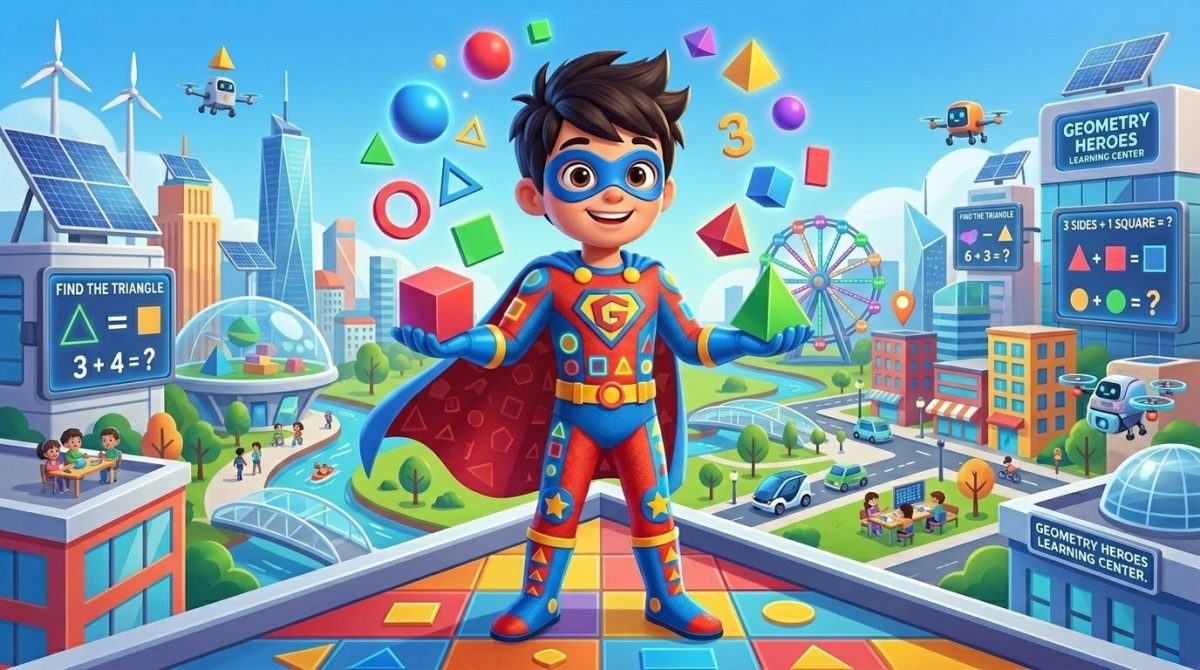
There’s something magical about watching a child’s face light up when they discover how shapes fit together to create something amazing. That’s precisely what Jr Geo does for millions of young viewers every time Team Umizoomi springs into action. This beloved character from Nick Jr has become a cornerstone of early childhood education, making mathematics fun and accessible to children aged two through five.
Jr Geo isn’t just another cartoon character. He’s a carefully designed educational tool wrapped in an entertaining superhero package. The character brings geometry to life in ways that traditional classroom settings often struggle to achieve. Parents and educators consistently praise the way Jr Geo captures children’s attention while seamlessly teaching fundamental math concepts through storytelling and adventure.
If you’re a parent, educator, or simply curious about children’s educational programming, understanding Jr Geo’s role in Team Umizoomi can help you appreciate why this character has maintained such staying power in the landscape of children’s television. This guide explores everything you need to know about Jr Geo, his unique abilities, and his impact on early childhood learning.
Table of Contents
ToggleWho is Jr Geo on Nick Jr?
Jr Geo is one of three main characters in Team Umizoomi, a Nick Jr animated series that premiered in January 2010. Created by Soo Kim, Michael Smith, and Jennifer Twomey, the show ran for four successful seasons across 80 episodes, establishing itself as a flagship educational program for preschoolers.
The character stands out as the team’s dedicated shape expert and master builder. While his sister Milli focuses on patterns and measurements, and Bot provides practical support, Jr Geo specializes entirely in geometric thinking. He’s visually distinctive with his blue hair, blue outfit, blue roller skates, and the iconic orange Shape Belt that serves as his primary tool.
Jr Geo is eight years old within the show’s universe, making him relatable to slightly older preschoolers. His personality embodies enthusiasm, determination, and a genuine “go, go, go” attitude toward problem-solving. He shows his feelings more openly than the other team members and demonstrates that it’s okay to be sensitive while still being brave and capable. This balanced character design helps young viewers develop emotional intelligence alongside mathematical thinking.
The voice acting has contributed significantly to the character’s appeal. Ethan Kempner portrayed Jr Geo throughout the first three seasons, giving the character a distinctive vocal personality that kids found engaging and memorable. The show’s presence extended far beyond television screens, with Nick Jr positioning Team Umizoomi prominently on their website, creating games, printable activities, and interactive content that let children engage with Jr Geo independently.
The Incredible Shape Belt: Jr Geo’s Superpower
The Shape Belt is where Jr Geo’s magic happens. This is no ordinary tool. It’s a teaching instrument designed to make geometric principles tangible and exciting for young minds. With a single phrase, “Super Shapes,” Jr Geo can pull geometric shapes from his belt and combine them into functional objects that solve real problems within the show’s storyline.
What makes this superpower brilliant from an educational standpoint is its consistency and clarity. Children watching Jr Geo use his Shape Belt repeatedly encounter the same shapes in different configurations. Triangles become the steep slope of a ramp. Rectangles form the platform for a bridge. Circles become wheels. The repetition builds shape recognition naturally, without ever feeling like a forced lesson.
The Shape Belt doesn’t just produce random shapes. Each episode presents Jr Geo with a specific problem that requires geometric thinking. Maybe the team needs to build a submarine to navigate underwater. Perhaps they need a vehicle to traverse difficult terrain. Whatever the challenge, Jr Geo demonstrates that shapes are building blocks of everything around us.
Beyond the basic Shape Belt, Jr Geo has access to additional tools that enhance his geometric capabilities. The Shape Magnet helps him locate shapes even when they’re hidden behind obstacles. The Shape Splitter allows him to divide shapes into smaller components. These tools expand his problem-solving toolkit while introducing children to more sophisticated spatial reasoning concepts.
Team Umizoomi: Jr Geo’s Role in the Adventure
Understanding Jr Geo means understanding Team Umizoomi as a whole. The show operates on a simple but effective formula. Each episode begins with someone in Umi City facing a problem. The character calls for help, and Team Umizoomi springs into action using their Mighty Math Powers.
Milli, Jr Geo’s twin sister, handles everything related to patterns. She can identify patterns, extend them, and even become living patterns herself through her Pattern Power ability. When a pattern needs matching or completing, Milli’s expertise takes center stage. Bot, the green robot companion, serves as the team’s technology expert and emotional support. He can display maps, information, and images through his belly screen.
Jr Geo’s specific role is architectural and structural. Whenever the team needs something built, Jr Geo steps forward with a blueprint and a plan. He often presents the problem in visual form, showing exactly what shapes they’ll need and how they’ll fit together. This interactive element becomes crucial because the show directly addresses viewers at home, asking them to help Jr Geo identify shapes needed for the blueprint.
This fourth-wall interaction is pedagogically brilliant. Children feel like active participants in solving the problem rather than passive viewers watching a story unfold. They’re not just watching Jr Geo solve problems with geometry. They’re helping him, which creates investment in the outcome and reinforces learning through active engagement.
The team dynamic shows children how different skills contribute to overall success. It’s not that geometry is more important than patterns or technology. Rather, these different types of thinking work together. Nick Jr Geo Team Umizoomi episodes consistently model this collaborative problem-solving approach, teaching children that different people have different strengths and that working together produces better results.
Jr Geo and the Team Umizoomi Doctor Bot Episodes
One of the most interesting character dynamics in the series involves Jr Geo and Doctor Bot. In several episodes, Bot takes on a diagnostic role, acting as a doctor who identifies what’s wrong with a machine, creature, or system. Jr Geo then uses his shape-building abilities to construct the physical solution that Bot has prescribed.
This partnership beautifully demonstrates how analytical thinking and hands-on creation complement each other. Bot analyzes the problem scientifically. Jr Geo implements the solution practically. Children watching these Nick Jr Geo Team Umizoomi Doctor Bot episodes learn that good problem-solving often requires both perspectives.
The Doctor Bot episodes became fan favorites, with many children enjoying the crossover of medical and building concepts. Parents report that kids often recreate these scenarios during playtime, with one child diagnosing imaginary problems while another builds solutions. This spontaneous reenactment shows that the teaching has penetrated beyond the television experience into actual play behavior, which represents genuine learning.
These episodes also normalize the idea that sometimes you need to call an expert for help. Jr Geo doesn’t pretend to understand everything. He recognizes when someone with specialized knowledge like Doctor Bot has valuable insights. This models healthy help-seeking behavior for young viewers.
Geo Safari Jr: Complementing the Learning Experience
While Jr Geo focuses on shapes through television, Geo Safari Jr represents a distinct but related approach to early childhood learning through hands-on exploration. Made by Educational Insights, the Geo Safari Jr product line includes talking globes, interactive microscopes, binoculars, and various exploration kits designed for children aged three and up.
Though Geo Safari Jr isn’t directly connected to the Nick Jr character, parents often search for both together, recognizing that they share similar educational philosophies. Both emphasize learning through interactive discovery. Both use technology in age-appropriate ways. Both respect children’s natural curiosity about the world.
The Geo Safari Jr Talking Globe guides young learners through countries, continents, oceans, and landmarks. The interactive microscope lets children examine insects and small objects while hearing fascinating facts. These products extend learning beyond shapes and geometry into broader scientific exploration.
Many families use Geo Safari Jr products alongside Team Umizoomi viewing. A child who grows up watching Jr Geo build structures might naturally gravitate toward using a Geo Safari Jr microscope to examine insects or a Talking Globe to explore the world. The overlapping educational philosophy creates a coherent learning pathway that extends throughout early childhood.
Why Jr Geo Matters for Child Development
The educational research behind Team Umizoomi is solid. Studies consistently show that curriculum-integrated children’s programming produces measurable improvements in mathematical thinking and problem-solving abilities. Jr Geo specifically targets foundational geometric concepts that become building blocks for more advanced mathematics.
Early exposure to geometry builds spatial reasoning skills. These skills correlate strongly with later success in STEM fields. Children who spend time with Jr Geo’s Shape Belt are developing the neural pathways that support three-dimensional thinking, mental rotation, and spatial problem-solving.
Beyond pure mathematics, Jr Geo models important character traits. He demonstrates persistence. Whenever a shape combination doesn’t work initially, Jr Geo doesn’t give up. He keeps trying different approaches. He shows confidence in his abilities while remaining open to input from his teammates. He celebrates team victories rather than individual glory. These soft skills matter just as much as the geometric knowledge he’s teaching.
The character also normalizes emotions. Jr Geo is sensitive, sometimes nervous before big challenges, yet still brave enough to face them. This emotional authenticity helps children understand that having feelings doesn’t diminish capability. You can feel worried and still accomplish amazing things.
For educators and parents, Jr Geo represents affordable, accessible, high-quality educational content. Unlike formal math tutoring or enrichment programs, Team Umizoomi comes through standard television access or streaming services. The lessons don’t feel like academic work. They feel like entertainment, which may actually be more effective for genuine learning retention.
The Legacy and Current Availability
Though Team Umizoomi completed its initial run in 2015, the show’s legacy endures. Episodes remain available on Paramount Plus, YouTube Kids, and various streaming platforms depending on region and subscription status. A generation of children grew up with Jr Geo, and parents continue introducing the character to younger siblings and their own children.
The show experienced a brief return to broadcast in November 2022, introducing Jr Geo to viewers who’d missed the original run. This continued interest speaks to the character’s effectiveness and appeal. Unlike trend-based children’s programming that fades quickly, Jr Geo has proven to have genuine staying power.
The materials used in creating Team Umizoomi episodes reflect quality standards that parents and educators appreciate. The animation is clear and colorful without being overstimulating. The pacing allows children time to process information. The dialogue uses age-appropriate vocabulary without condescending to young viewers. These production quality factors contributed significantly to the show’s success and continued relevance.
Frequently Asked Questions
What exactly does Jr Geo’s Shape Belt do?
Jr Geo’s Shape Belt is his primary tool for solving problems. When he says “Super Shapes,” the belt produces geometric shapes like triangles, squares, circles, and rectangles. He then combines these shapes to build whatever structure the team needs. The Shape Belt essentially makes geometry tangible and interactive for young viewers, turning abstract mathematical concepts into concrete objects they can see and understand.
How old is Jr Geo supposed to be?
Within the show’s universe, Jr Geo is eight years old, making him slightly older than the show’s target audience of three to five year olds. This age gap is intentional, creating a relatable but slightly aspirational character. Children see Jr Geo as competent and capable while still being close to their own age group.
Is Geo Safari Jr the same character as Jr Geo?
No, these are separate entities entirely. Jr Geo is the Nick Jr character from Team Umizoomi, while Geo Safari Jr is an educational product line by Educational Insights. The similar names cause confusion, but they represent different approaches to early childhood learning. However, both share the goal of making learning interactive and fun.
Where can families watch Team Umizoomi and Jr Geo adventures?
Team Umizoomi is available on Paramount Plus, which includes Nick Jr content. Select episodes appear on YouTube Kids, and availability varies by region and streaming service. Some libraries also carry DVD collections. Checking your local streaming platforms for current availability options is your best approach.
What makes Jr Geo an effective educational character?
Jr Geo works as an educational tool because he consistently models geometric thinking through storytelling rather than formal instruction. Children learn by watching, helping him solve problems, and seeing shapes applied to real challenges. His personality makes learning feel like adventure rather than work, and his collaborative approach shows that different types of thinking work together.