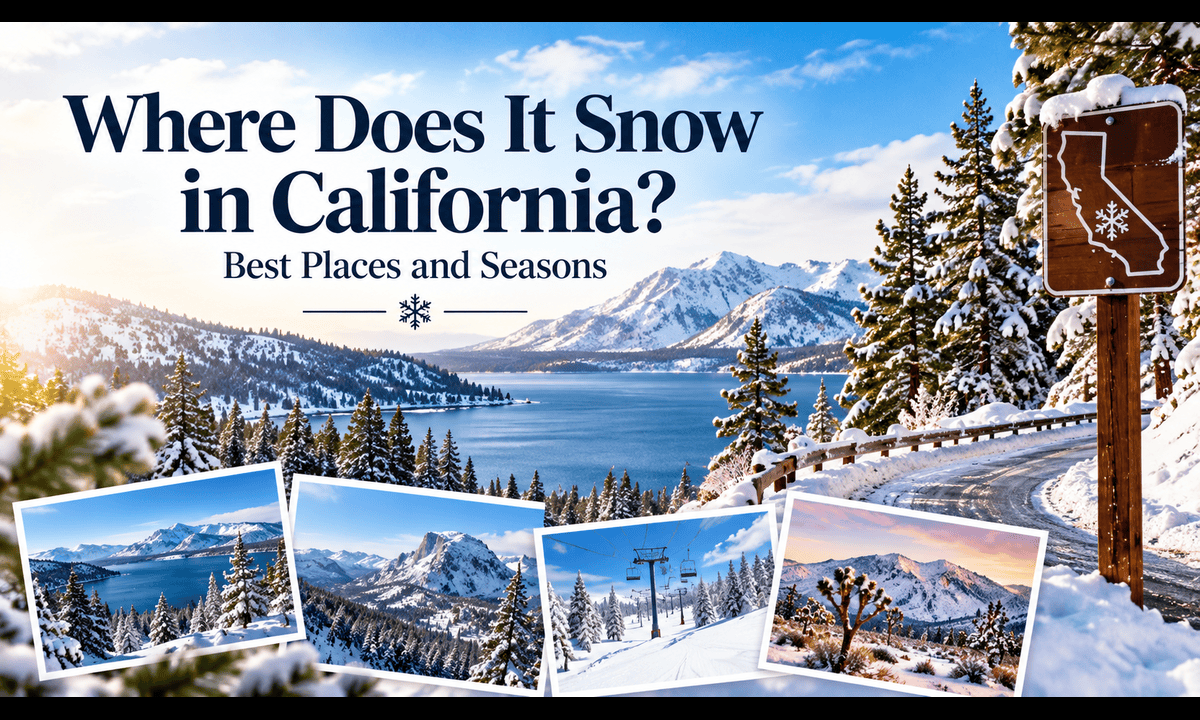
Quick answer: Most of California’s snow falls in the Sierra Nevada, around Lake Tahoe, Truckee, Yosemite and Mammoth Lakes, usually between November and April. You can also find snow in the Southern California mountains (Big Bear, Mount Baldy, Wrightwood), in the far north at Mount Shasta and Lassen, and occasionally in the desert. The coast and big cities almost never see it.
Picture California and you probably see palm trees, surfboards and long beach days. So it surprises plenty of visitors that the same state has ski resorts, sledding hills and mountain roads that close under feet of snow.
That contrast is why the question trips people up. This guide sorts it out: the main snow regions, what each is best for, when to go, how California’s chain-control rules work, and the mistakes that catch out first-time winter visitors.
Table of Contents
ToggleCalifornia Snow at a Glance
| Region | Where to look | Best known for |
| Northern Sierra | Lake Tahoe, Truckee | Big ski resorts, lakeside winter towns |
| Eastern Sierra | Mammoth Lakes, June Lake | Long ski season, quieter villages |
| Sierra national parks | Yosemite, Sequoia, Kings Canyon | Snowy valleys, giant trees dusted in white |
| Far north | Mount Shasta, Lassen | Volcanic peaks, fewer crowds |
| Southern California mountains | Big Bear, Mount Baldy, Wrightwood, Lake Arrowhead | Snow within day-trip range of Los Angeles |
| Southern desert mountains | Mount San Jacinto, Idyllwild | Snow just above desert towns |
| San Diego County | Julian, Mount Laguna | Light snow for a day out |
Why Does a Sunny State Get So Much Snow?
Pacific storms meet tall mountains
California’s wet season runs roughly from November to April. Storms roll in off the Pacific, hit the mountains, and are forced upward. As the air climbs it cools, and at higher elevations the rain turns into snow.
The Sierra Nevada, the long range that runs down the eastern side of the state, does most of the work. Its peaks are among the highest in the country, which is why the snowiest places in California are almost always the highest ones.
Elevation is the real answer
Height matters more than latitude. A sea-level town in the far north can stay snow-free all winter, while a peak in the south wears a thick white cap. Annual totals vary enormously from place to place and year to year, so treat every figure below as an average, not a promise.
Northern California: The Big Snow Country
Lake Tahoe and Truckee
If you want the classic answer to where it snows in California, start here. The mountains around Lake Tahoe collect several hundred inches a year at their highest points, and the whole area is built around winter. South Lake Tahoe makes a good base, with Heavenly’s scenic gondola, lakeside walks and winter hiking nearby.
Truckee, a short drive north, is often ranked among the snowiest towns in the country and sits close to ski areas such as Northstar and to Donner Lake.
Mount Shasta and Lassen Volcanic National Park
Further north, the snow comes with a quieter crowd. The town of Mount Shasta gets around 60 inches a year, making it a calmer alternative to Tahoe.
Lassen Volcanic National Park is the surprise. Parts of it see about 142 days a year with at least an inch of snow on the ground, and the higher areas pick up hundreds of inches. It’s ideal if you’d rather snowshoe through volcanic scenery than queue for a chairlift.
Nevada City and the foothills
Even the Gold Country foothills see flurries. Nevada City, at roughly 2,500 feet, averages about 15 inches a year, so expect a dusting rather than a deep blanket.
The Sierra Nevada Parks and the Eastern Sierra
Yosemite, Sequoia and Kings Canyon
Yosemite Valley averages around 36 inches of snow a year, with far more at higher elevations like Tuolumne Meadows. Most of the park stays snowy from about November through April. It’s a lovely, quieter time to visit, but it comes with limits. Tioga Pass shuts for the winter, which cuts off Tuolumne Meadows, and Glacier Point and Taft Point are out of reach until the roads reopen.
Sequoia and Kings Canyon get roughly 40 to 45 inches at middle elevations. Seeing giant sequoias with snow on their branches is one of the best sights in the state. Kings Canyon is the quieter of the two and is popular for sledding and snowshoeing.
Mammoth Lakes, June Lake and Convict Lake
On the eastern side of the range, Mammoth Mountain is among the state’s most dependable ski areas, with around 300 inches of snow a year and a season that can stretch from early November into late May in a good year.
Nearby June Lake is about 20 minutes away and noticeably calmer, while Convict Lake is a lovely spot for a snowshoe walk beside a frozen shoreline. Non-skiers can still fill a weekend here with cross-country skiing, ice skating and long lunches.
Yes, It Snows in Southern California Too
This is the part that makes people double-take. Within a couple of hours of Los Angeles, you can stand in real snow.
The San Bernardino Mountains
Big Bear Lake is the best-known snow day out for Angelenos. It gets roughly 67 inches a year, and Snow Summit relies on snowmaking for consistency. Lake Arrowhead averages about 40 inches and makes a good weekend base for non-skiers. Running Springs, near Snow Valley, is known for some of the most natural snowfall in the region and is friendly for beginners.
Mount Baldy and Wrightwood
Mount Baldy is about 40 miles from downtown Los Angeles, and its summit area tops 10,000 feet. Wrightwood and Mountain High are about 60 miles from downtown and make an easy half-day trip when conditions are right.
Palm Springs, Idyllwild and Mount Pinos
Mount San Jacinto rises above Palm Springs to more than 10,000 feet, and the Palm Springs Aerial Tramway carries visitors up to a top station at about 8,500 feet. It’s one of the stranger sights in the state: desert at the bottom, snow at the top.
Idyllwild, above 5,000 feet, gets light to moderate snow and suits a quiet cabin weekend rather than skiing. Mount Pinos, in Ventura County, receives roughly three to seven feet a year.
San Diego County
Even San Diego has a snow corner. Julian gets around 24 inches a year, and Mount Laguna, at about 6,000 feet, collects roughly 13. It isn’t skiing territory, but it’s enough for snowball fights and a story to tell.
Where It Almost Never Snows
Los Angeles, San Francisco, San Diego and the rest of the coast are, for practical purposes, snow-free. The ocean keeps winter temperatures mild, and the snowy mountains are inland or well above sea level. Snow in a coastal city is a rare headline, not something to plan around.
The deserts are a mixed case. Parts of the Mojave can pick up small amounts of snow when a cold storm drops down from the Pacific Northwest, but it rarely lasts.
If a winter trip appeals but icy roads don’t, you can always stay at sea level. Our guide to things to do in La Jolla covers a sunny coastal alternative for the same time of year.
When Is Snow Season in California?
There’s no single start date. Snow can fall at higher elevations at almost any point in the cold months, and big storms can turn up earlier or later than expected. As a general guide:
| Area | Typical snow season |
| Mammoth Mountain | Early November to late May |
| Lake Tahoe | Late November to late April |
| Yosemite (most of the park) | November to April |
| Mount Baldy, Big Bear, Mountain High | Late November to early April |
| Wrightwood, Lake Arrowhead, Running Springs | Late November to early March |
Many winter travellers target January to March for the best chance of a solid base, but a wet December or a late storm can change the picture. Whatever the calendar says, check current snow reports in the days before you travel.
Driving in Snow: California Chain Controls Explained
If you’re renting a car (hire car, for UK readers), this is the section that saves trips.
When snow is falling or has settled, Caltrans can impose chain controls on mountain roads. There are three main levels:
- R-1: Chains are required unless your vehicle is a passenger car or light truck under 6,000 lbs with snow-tread tires on at least two drive wheels. You still need to carry chains.
- R-2: Ordinary cars must fit chains. Four-wheel-drive and all-wheel-drive vehicles can pass without them only if they have snow-tread tires on all four wheels, and they must still carry chains.
- R-3: Chains are required on every vehicle, without exception. Roads often close before R-3 is reached.
A few practical points matter:
- Snow-tread tires need an M+S marking and at least 6/32 inch of tread. Studded tires are permitted from November 1 to April 30, but they don’t replace chains.
- Carry chains even if you have a 4WD. If conditions worsen or you lose control, stop and fit them.
- Vehicles with no traction device may not enter a chain-control area.
- Roads that commonly see controls include Interstate 80 over Donner Summit, US 50 over Echo Summit, State Route 89 over Luther Pass and State Route 88 over Carson Pass.
- Check conditions at roads.dot.ca.gov or call 800-427-7623 before you leave. Posted signs and CHP instructions always override anything you read online.
How to Plan a Snow Trip in California
The right plan depends on how much experience you have.
If you’re a beginner
- Pick a spot close to a big city, such as Big Bear, Mount Baldy or Wrightwood, where the roads are shorter and services are close.
- Go on a weekday if possible. Weekends fill the roads and car parks.
- Rent or buy chains in advance and practise fitting them at home, in gloves, before the trip.
- Fill the tank before you climb.
If you’ve done it before
- Choose a base town rather than a day trip. A night in Truckee, South Lake Tahoe or Mammoth Lakes means you can start early and avoid the afternoon crush.
- Watch the storm forecast, not just the temperature. A fresh dump can mean great skiing and slow roads at the same time.
- Carry food, water, warm layers and a charged phone, in case a closure leaves you stuck.
Common Mistakes First-Timers Make
- Assuming “California” means warm everywhere. Pack real layers if you’re heading above about 5,000 feet.
- Skipping the chains. Even if you have a 4WD, you may still be required to carry them.
- Relying on one weather app. Use Caltrans road reports and a mountain snow report as well.
- Leaving too late. Arriving after mid-afternoon in a storm can mean dark roads and delays.
- Dodging checkpoints on side roads. It causes spinouts and blocks the way for emergency vehicles.
Frequently Asked Questions
Where does it snow in California?
Mostly in the Sierra Nevada, including Lake Tahoe, Truckee, Yosemite and Mammoth Lakes, and in mountain areas such as Mount Shasta, Lassen, Big Bear and Mount Baldy. Snow is rare on the coast and in the big cities.
Does it snow in Southern California?
Yes, in the mountains. Big Bear Lake, Lake Arrowhead, Mount Baldy, Wrightwood and Mount San Jacinto all get regular snow in winter, usually from late November to early April.
What is the snowiest place in California?
The highest parts of the Sierra Nevada receive the most, with Lake Tahoe’s high peaks collecting several hundred inches a year and Mount Whitney, the highest summit in the range, often named as the snowiest spot.
Does it snow in Los Angeles or San Francisco?
Not in any way that matters for planning. Both cities are at or near sea level and stay snow-free, though the mountains around them get snow, and you can reach it by car in a few hours.
Do I need snow chains in California?
You may. Caltrans can require chains on mountain roads during storms, and you must carry them to enter a chain-control area even if your vehicle qualifies to pass without fitting them.