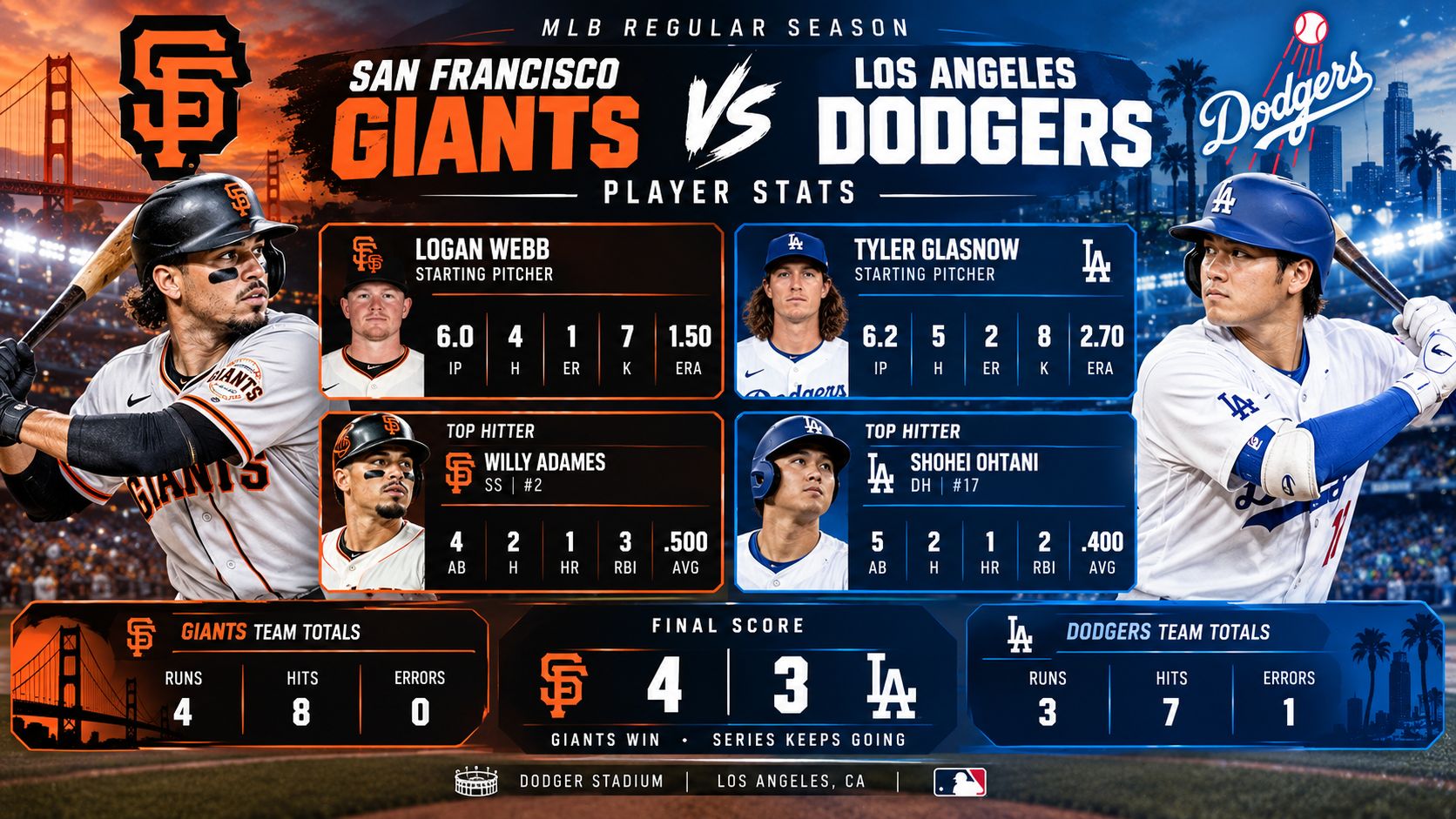
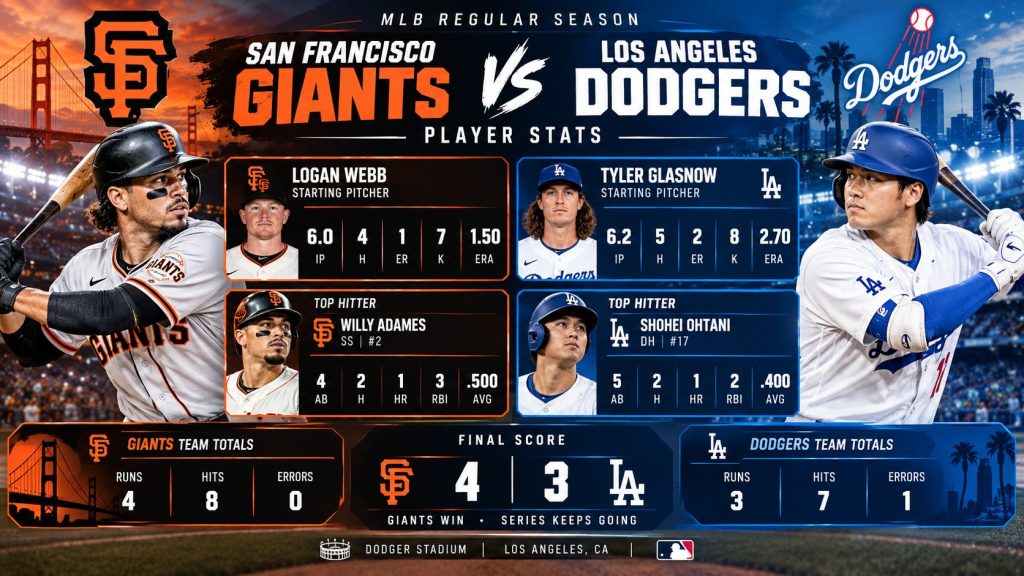
Anyone digging through San Francisco Giants vs Dodgers match player stats this season is really asking one question: did the Giants finally have an answer for the defending champions, or did the gap between these two clubs just keep growing? By September, the standings gave a blunt answer. Los Angeles sat comfortably atop the NL West with a record well north of .500, while San Francisco had slid into the division’s basement. But the season series between these two teams told a more interesting story earlier in the year, and the individual performances buried in those box scores explain a lot about why both directions happened.
This isn’t a generic recap. It’s a look at the specific games, pitching matchups, and player lines that actually shaped this rivalry in 2026, plus how to read that kind of stat sheet without missing the parts that matter.
Table of Contents
ToggleThe April Series That Set the Tone
The Dodgers opened their first regular season series against the Giants at Oracle Park in late April, and it didn’t go the way Los Angeles expected. Game one turned on a defensive breakdown from reigning World Series MVP Yoshinobu Yamamoto, who gave up three runs in the bottom of the first after miscues let Willy Adames, Luis Arraez, and Matt Chapman cash in. On the mound for San Francisco, Landen Roupp answered with five strong innings, striking out seven Dodgers hitters and allowing just the one run the whole outing. The Dodgers clawed back a run late on a bases loaded walk to Hyeseong Kim that scored Teoscar Hernández, but it wasn’t enough. Giants won game one 3-1.
Game two was the pitching duel fans actually wanted to see. Tyler Mahle threw seven shutout innings for San Francisco, while Shohei Ohtani matched him for six scoreless frames before handing the ball to reliever Jack Dreyer. That’s where the Giants made their move. Jung Hoo Lee singled, Heliot Ramos followed with a single of his own, and catcher Patrick Bailey turned on a pitch from Dreyer for a three run homer that put the game away. Giants won 3-0, and the loss ended Ohtani’s on-base streak at 53 games, the longest active run in the league at that point and the longest by any player since 2006. That’s not a small detail buried in a box score. That’s the kind of single stat line that defines a series.
Los Angeles avoided the sweep in game three behind Tyler Glasnow, who worked eight innings and allowed just one hit. San Francisco starter Logan Webb gave up an early run when Dalton Rushing singled home Max Muncy, and the Dodgers tacked on more in the fourth after a Drew Gilbert throwing error let Kyle Tucker score, followed by a Kim single that brought in Muncy again. Dodgers took the finale 3-0, but the Giants still walked away with the series, two games to one.
Why That First Series Mattered More Than the Final Standings Suggest
San Francisco’s new manager, Tony Vitello, took over a team that hadn’t exactly been expected to compete with the Dodgers, and winning that opening series against the reigning champs gave the fan base a reason to believe the “Beat LA” mentality still had some teeth. It didn’t hold up over the full season, but it’s worth separating the early season series results from what the standings eventually showed. A three game sample tells you about matchups, pitching form, and a couple of lucky bounces. It doesn’t tell you much about which team is actually built better over 162 games, and the rest of the season made that gap painfully clear for Giants fans.
How the Season Series Actually Played Out
By mid May, the two teams had already met seven times, and San Francisco somehow held a 4-3 edge in the season series heading into their May 14 matchup at Dodger Stadium. That game came down to a pitching matchup between Roupp, who’d built a strong early season ERA in the low threes with over fifty strikeouts, and Dodgers righty Emmet Sheehan, who was working through a rougher stretch with an ERA closer to five. Los Angeles won that game and evened the ledger, and results from there tilted the Dodgers’ way as the summer wore on, consistent with the massive gap that eventually opened up in the standings.
This is the part that gets lost when people just search for “player stats” without context. A single series result, or even a full season series between two teams, doesn’t move the needle on the standings the way people assume. The Dodgers can lose a rivalry series in April and still finish twenty games ahead of the same opponent in September, because a division race is decided against the other twenty nine teams too, not just head to head meetings. San Francisco’s overall record collapsed over the summer even while their record against LA specifically stayed competitive for a stretch, which tells you their problems were broader than one rival.
Which Players’ Stats Are Actually Worth Tracking Here
If you’re trying to make sense of this matchup going forward, focus on a handful of names whose stat lines carry real weight in this specific rivalry. On the Giants’ pitching side, Logan Webb remains the anchor of the rotation and the guy you check first for innings pitched and walk rate, since his ability to work deep into games sets the tone for San Francisco’s bullpen usage all series long. Roupp’s strikeout rate is the number worth watching for a Giants team that’s needed swing and miss stuff to cover for an offense that’s struggled to hit its way out of trouble.
For the Dodgers, Yamamoto and Glasnow anchor a rotation that can dominate a series even when the lineup goes quiet, and their walks and hits per inning numbers matter more than their win-loss record on any given day. Ohtani’s presence changes how you read every stat line around him, both as a hitter whose on-base streaks and slugging numbers set the tone for the whole lineup, and as a pitcher whose innings limit affects how the bullpen gets used behind him. Muncy, Tucker, and Betts round out a lineup deep enough that a single shutdown pitching performance from the Giants rarely holds up over a full series.
A Note on Reading Stat Lines Correctly
People often glance at a box score, see a home run or a big strikeout total, and assume that single game defines a player’s form. It usually doesn’t. A three strikeout, no walk outing from a starter looks great on paper but means less if it came against a lineup missing its top three hitters to injury or rest. Batting average in a three game series is a tiny sample that swings wildly on a couple of bloop hits or hard hit outs. The more reliable read comes from stacking multiple outings together: a pitcher’s WHIP and strikeout rate across a full month tell you far more than any single line, and a hitter’s on-base percentage across a homestand beats a single game’s batting average every time.
This Rivalry Runs Deeper Than One Season
Giants and Dodgers have been playing each other for roughly a century and a half, dating back to their days as New York and Brooklyn clubs before both moved west together in the same offseason. Over that stretch the head to head record sits about as close to even as two franchises can get, which is part of why a single series between them still draws more attention than a random midweek matchup against a non-divisional opponent. The Dodgers have owned the more recent playoff history between the two, including a tense divisional round matchup a few years back, while the regular season ledger has swung back and forth depending on which era of each roster you’re looking at.
That long history is worth keeping in mind when you’re evaluating a stat line from any single game. A pitcher having a rough outing against this particular opponent doesn’t necessarily reflect a decline in stuff or command, since both rosters are built around lineups deep enough to punish one mistake pitch into a crooked number. Context from the standings, injury reports, and recent form matters just as much as the raw numbers sitting in the box score.
What Separated These Two Teams by Late Season
The wider gap that showed up in the standings by September wasn’t really about what happened in their head to head meetings. Los Angeles built a deep, well balanced roster capable of grinding out wins even on nights when the marquee names went quiet, and their pitching depth meant a rough start rarely turned into a lost week. San Francisco’s issues were more structural: an offense that struggled to string together innings consistently, and a lineup that didn’t have enough thump behind its top few hitters to bail out a shaky start from the rotation. Those are season long patterns, and they show up far more clearly in monthly team batting and ERA splits than in any individual box score from a three game set against one rival.
If you’re trying to project how a future Giants-Dodgers series might go, team level trends over the prior month are a better guide than pulling up the box score from their last meeting. Roster health, current form, and who’s actually starting on the mound that day will tell you more than a stat line from a series played months earlier.
Frequently Asked Questions
Who’s led the season series between the Giants and Dodgers in 2026?
San Francisco actually held the early edge, winning their first head to head series in April and briefly holding a slight advantage in the season series through mid May. Los Angeles pulled ahead as the summer progressed, consistent with the wider gap that opened up between the two teams in the standings.
What was the biggest individual stat line from their 2026 matchups?
Patrick Bailey’s three run home run off Jack Dreyer in the April series finale stands out, partly because of the moment and partly because it ended Shohei Ohtani’s 53-game on-base streak, the longest active streak in the league and the longest by any player since 2006.
Where can I find live, current player stats for the next Giants-Dodgers game?
MLB.com’s Gameday feature and ESPN’s box score pages update in real time during games and are the most reliable sources for current stat lines, since anything published as a season recap will already be dated by the time a new series starts.
Does winning the season series against a rival actually matter for playoff positioning?
It can matter as a tiebreaker in a close division race, but it’s rarely the deciding factor on its own. A team’s overall record against the full league determines playoff seeding far more than any single head to head series, which is exactly what played out between these two clubs this season.