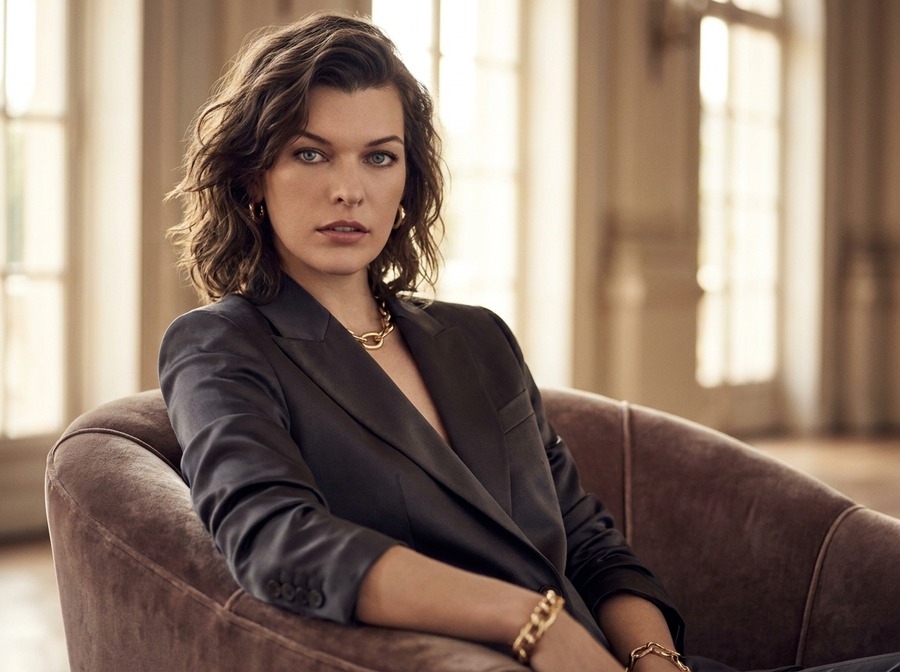
She was on the cover of Vogue before most people her age had figured out what they wanted to do with their lives. By the time she was fifteen, Milla Jovovich had already worked with two of the most legendary photographers in fashion history, appeared on international magazine covers, and landed her first leading film role. Most careers never reach that point. Hers was just getting started.
Born Milica Bogdanovna Jovovich on December 17, 1975, in Kyiv, Ukraine, she came into the world through a genuinely interesting mix of backgrounds. Her father, Bogdan Jovovic, was a Serbian doctor. Her mother, Galina Loginova, had been a respected actress in the Soviet Union. The family left when Milla was five, moving first to London and then settling eventually in Los Angeles. That move shaped a lot of who she became.
Growing up as a Ukrainian American actress in 1980s America was not exactly easy. The Cold War was still very much alive, and being Russian-speaking and Eastern European in Los Angeles carried a certain social weight. Milla has talked about that experience in interviews over the years, and there is a thread of it running through her music, her early film choices, and the quiet seriousness she brings to roles that other actors might treat more casually. Her mother’s influence mattered here too. Galina raised her daughter in the tradition of Russian classical theatre, the Stanislavski method, where emotional honesty is the foundation of everything. That is not a bad thing to absorb when you are young and trying to figure out what kind of performer you want to be.
Table of Contents
ToggleFrom a Magazine Cover at Eleven to the Top of the Fashion World
The modeling career started accidentally, the way the best ones often do. Photographer Herb Ritts shot young Milla for the cover of the Italian magazine Lei in 1987. She was eleven. That image caught the attention of Richard Avedon, who then featured her in Revlon’s long-running “Most Unforgettable Women in the World” campaign. From that point, things moved fast.
Over the next several years, this fashion model turned actress appeared on the covers of Vogue, Elle, Cosmopolitan, and well over a hundred other publications across the world. She fronted campaigns for L’Oreal, Versace, Christian Dior, Donna Karan, and Banana Republic. By her mid-twenties, Forbes magazine had ranked her the highest-paid model in the world, with reported annual earnings of around $10.5 million.
What made her stand out in that world was harder to explain than just good bone structure and the right look. Photographers who worked with her often noted something active in how she engaged with the camera. She was not simply standing in the frame and being photographed. She was doing something. That quality, whatever you want to call it, translated directly to film.
Early Acting Roles and Learning the Craft
Milla’s first screen appearance came in 1988, in the television film The Night Train to Kathmandu, followed shortly by her feature debut in Two Moon Junction. Three years later, at fifteen, she was cast as the lead in Return to the Blue Lagoon opposite Brian Krause. The role brought her a Young Artist Award nomination for Best Young Actress in a Motion Picture and put her name on the radar of casting directors across Hollywood.
What followed was a run of films that showed real range. She co-starred with Christian Slater in the comedy Kuffs in 1992. Later that same year she appeared as Mildred Harris in Chaplin, the Richard Attenborough film about Charlie Chaplin, working alongside Robert Downey Jr. In 1993, she was cast in Richard Linklater’s Dazed and Confused, though most of her scenes were cut from the final version. She did not take that quietly. She has said in interviews that losing most of her footage in that film frustrated her enough that she pulled back from acting for a while to focus on music instead.
That decision says something about her. She has never been someone who simply accepts whatever the industry hands her.
The Fifth Element and a Breakthrough Nobody Saw Coming
When director Luc Besson cast Milla Jovovich as Leeloo in The Fifth Element in 1997, it was not an obvious choice. She was known primarily as a model. She had film credits, but nothing that suggested she could anchor a big-budget science fiction blockbuster opposite Bruce Willis, Gary Oldman, and Chris Tucker.
She did more than hold her own. Leeloo became one of the most memorable characters in 1990s cinema, a supreme being with a childlike curiosity and a growing fury at what humans had done to their world. Milla and Besson created an entirely invented language for the character. She wore costumes that have been referenced in fashion and pop culture ever since. The performance was physical and emotional at once, and audiences responded to it in a way that went well beyond what the studio had predicted.
The film is still watched, still quoted, and still considered a high point in sci-fi action films. Milla Jovovich’s Leeloo is a large part of why.
She and Besson married that year, though the marriage did not last long. She then starred in his follow-up, The Messenger: The Story of Joan of Arc in 1999, wearing fifty pounds of armour to play a figure who has fascinated historians, artists, and filmmakers for six centuries. It was a physically grueling production and a demanding role, and she approached both without complaint.
The Resident Evil Films and What They Actually Meant
In 2001, Milla Jovovich was cast as Alice in the first Resident Evil film. Alice was a character written specifically for the screen, not taken directly from the Capcom video game series the films were based on. She was a former security operative who wakes up in an underground laboratory with no memory, surrounded by the aftermath of a catastrophic biological accident engineered by the Umbrella Corporation.
Milla had grown up around the game franchise. Her brother Marco was a devoted fan, and she has said she wanted to be part of the film specifically because of that connection. She auditioned in October 2000 and went through three callbacks before getting the role. Before a single day of filming began, she spent months in preparation:
- Karate and kickboxing training to build real combat foundations
- Firearms training and weapons handling over several months
- Full stunt coordination and martial arts work throughout production
The film was released in March 2002 and earned over $100 million worldwide. Critics were lukewarm. Audiences did not care. The Alice in Resident Evil actress became one of the defining action characters of the 2000s, and the franchise ran for six films across fourteen years:
- Resident Evil: Apocalypse (2004)
- Resident Evil: Extinction (2007)
- Resident Evil: Afterlife (2010)
- Resident Evil: Retribution (2012)
- Resident Evil: The Final Chapter (2016)
That final film earned over $312 million worldwide, the highest total of any entry in the series. Music channel VH1 gave Milla the title “reigning queen of kick-butt” during the height of the franchise, and AllMovie observed that despite the mixed critical reception the films received, they had unmistakably built her into an A-list Hollywood action movie star. Time Out, reviewing The Final Chapter, put it well when they noted that Milla Jovovich had grown stronger with each film, adding a “commanding stare” to the athleticism that had always been there.
The Resident Evil series also became the highest-grossing film franchise ever based on a video game. That is not a footnote. It is a genuinely significant cultural fact, and Milla Jovovich was the engine at the centre of it for fifteen years.
Music, Fashion Design, and a Creative Life on Her Own Terms
Alongside all the films and the modeling, Milla Jovovich has always made music. She began writing songs at fifteen and released her first album, The Divine Comedy, through EMI Records in 1994. The record drew on her experience as a Russian immigrant in America, leaning into European folk sounds and introspective lyrics. Reviews were warm. A second album, The People Tree Sessions, followed in 1998, and she has continued writing and recording ever since, releasing music through her personal website and contributing to various film soundtracks over the years.
In 2003, she co-founded the clothing label Jovovich-Hawk with fellow model Carmen Hawk. The line moved quickly into prominent retail spaces including Fred Segal and Harvey Nichols, and American Vogue included it on their list of “10 Things to Watch Out for in 2005.” The label closed in 2008, but while it existed it was considered a genuinely distinctive voice in fashion rather than a celebrity side project.
Readers of 5ive Magazine will be familiar with this kind of creative breadth. People who operate seriously across multiple disciplines usually have something to say in each of them, and Milla Jovovich has always had something to say.
Charitable Work and Life Away from the Camera
She has been involved with amfAR, the Foundation for AIDS Research, for many years, co-chairing their Cinema Against AIDS event at the Venice Film Festival alongside Elizabeth Taylor. She has also worked with the Ovarian Cancer Research Fund and the Wildlands Project, and has spoken publicly about human rights and environmental issues throughout her career.
In 2011, she performed and gave a speech at the birthday celebration of Mikhail Gorbachev. Her words were personal. She spoke about leaving the Soviet Union as a child, certain that her family would never see their relatives again, and about the role Gorbachev’s policies played in making a reunion possible. It was a moment that reminded people there is a real biography underneath the film roles.
She has been married to director Paul W. S. Anderson since 2009. Anderson wrote and directed the majority of the Resident Evil films, and their professional partnership gave the series a continuity that multi-film franchises rarely achieve. They have two daughters together, Ever and Dashiel.
She has also spoken about maintaining a daily practice that includes yoga and meditation, and about keeping a private diary since childhood. She has mentioned plans to eventually publish an autobiography. Given what she has lived through and what she has seen, it would be worth reading.
Recent Work and What Comes Next
Milla Jovovich is still very much working. In 2020, she starred in Monster Hunter alongside Dave Bautista, another video game adaptation with Anderson directing. The film leaned fully into creature-feature spectacle, and she delivered the kind of committed physical performance that audiences have come to expect from her.
More recently, she appeared in In the Lost Lands, based on a short story by George R. R. Martin. She plays Gray Alys, a sorceress, in a dark fantasy setting that is considerably quieter and stranger than anything from Resident Evil. The fact that she can move between those two registers without it feeling forced says a lot. Additional projects including Worldbreaker and Protector continue to keep her in the genre space where her career has always felt most natural.
She has been working since she was eleven years old. She has outlasted trends, franchises, and the kind of industry shifts that end most careers before they reach this point. That is not luck. That is someone who has always taken their craft seriously, even when the work itself was not being taken seriously by critics.
Milla Jovovich started on the cover of a magazine and built something much larger than that into a genuine, lasting career. The story is still going.
Frequently Asked Questions
Who is Milla Jovovich and where was she born?
Milla Jovovich was born on December 17, 1975, in Kyiv, Ukraine, which was then part of the Soviet Union. She is of Serbian and Russian heritage and emigrated to the United States at the age of five. She is an actress, model, musician, and fashion designer who has worked across all four disciplines throughout her career.
What are the most famous Milla Jovovich movies?
Her most recognized films are The Fifth Element (1997), The Messenger: The Story of Joan of Arc (1999), the six-film Resident Evil series (2002 to 2016), Ultraviolet (2006), Monster Hunter (2020), and In the Lost Lands. Earlier in her career she appeared in Kuffs (1992), Chaplin (1992), and Dazed and Confused (1993).
How many Resident Evil films did Milla Jovovich appear in?
She appeared in all six original Resident Evil films as the character Alice. The series ran from the first film in 2002 through Resident Evil: The Final Chapter in 2016. The franchise became the highest-grossing film series ever based on a video game, and the final installment alone earned over $312 million worldwide.
Was Milla Jovovich a supermodel before acting?
Yes. Her modeling career began when she was around eleven years old, following a shoot with photographer Herb Ritts for the Italian magazine Lei. She went on to appear on over a hundred magazine covers worldwide and worked with brands including Christian Dior, Versace, Revlon, L’Oreal, and Donna Karan. In 2004, Forbes named her the highest-paid model in the world.