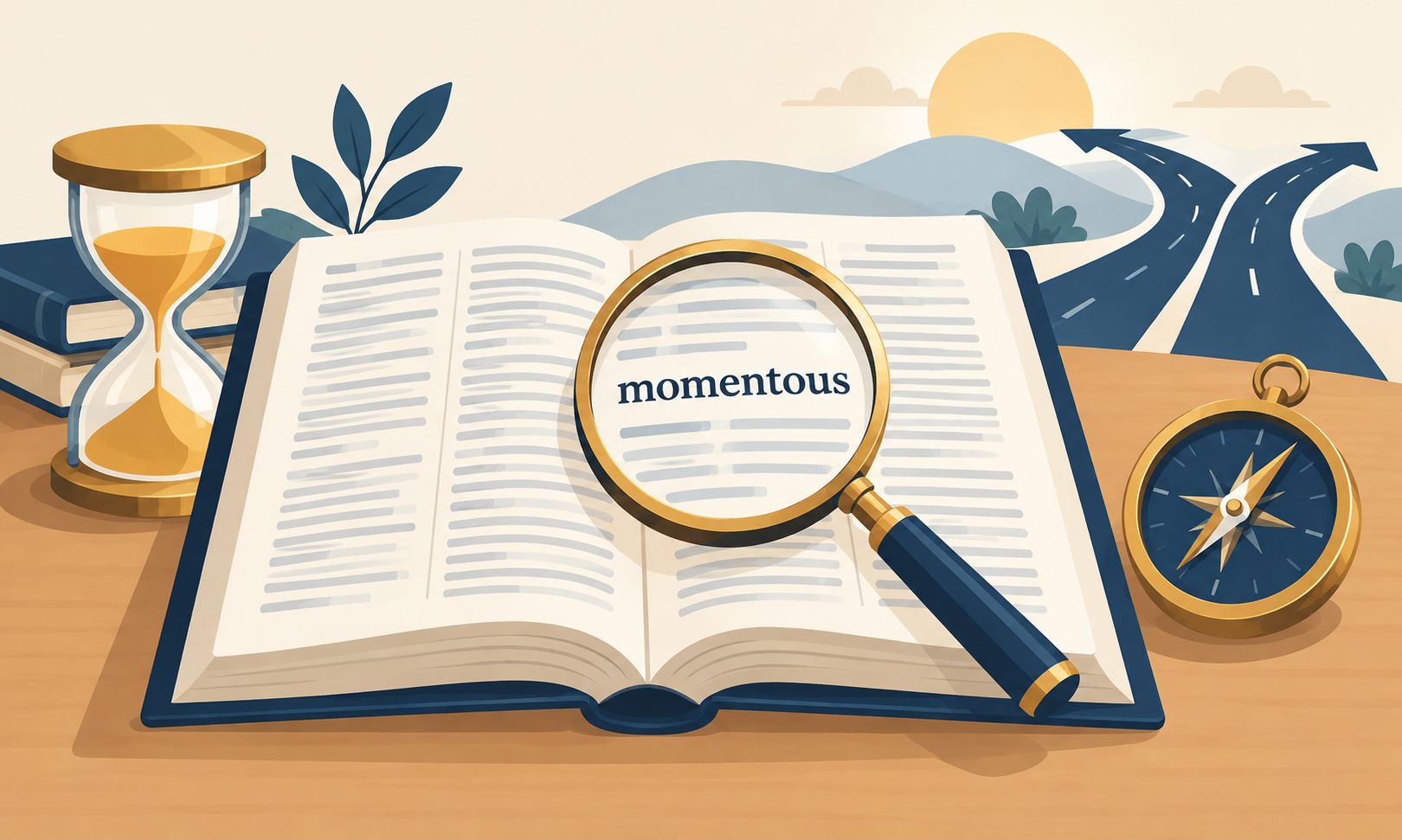
Momentous means significant in a way that will matter for a long time, not just impressive or exciting. That distinction trips people up constantly, because the word gets reached for whenever something feels big in the moment, a strong game, a nice promotion, a decent vacation, when what the speaker actually means is memorable or exciting, not momentous. A momentous event is one that changes the course of something, a life, a country, a field of study. The bar is higher than most casual usage assumes.
This article breaks down what momentous actually means, where it comes from, how it differs from the words people confuse it with, and when you should actually reach for it instead of something more common.
Table of Contents
ToggleWhat Momentous Actually Means
The core definition is straightforward: of great importance or significance, especially because of long-term consequences. Merriam-Webster and Oxford both anchor the word to consequence and lasting impact rather than intensity or emotion. A momentous decision isn’t just a hard one or an emotional one; it’s one that changes what happens afterward in a lasting way.
That’s the piece people miss. Something can be emotionally intense without being momentous, and something can be momentous without feeling dramatic at all in the moment. A quiet vote in a small committee room can be momentous if it sets a legal precedent that shapes decades of future rulings, even though nobody in that room felt like they were living through history.
Where the Word Comes From
Momentous traces back to the Latin momentum, which originally meant movement or moving power, and by extension came to mean a cause or influence significant enough to tip the balance of something. English absorbed “moment” from this root with the sense of importance, not just a unit of time, and momentous is built directly from that sense with the -ous suffix meaning “full of” or “characterized by.”
This etymology explains something useful: the “moment” in momentous was never really about a brief span of time. It was about weight, about something having enough force to shift an outcome. That’s worth knowing because it directly explains why momentous and momentary, despite looking like siblings, come from almost opposite ideas.
Momentous vs. Momentary: The Confusion That Actually Matters
This is the mix-up I see most often, including from strong writers who should know better. Momentary means lasting only a moment, brief, fleeting. Momentous means significant, weighty, consequential. They share four letters and a common ancestor in “moment,” but they’ve drifted into describing nearly opposite qualities: one is about duration, the other about importance.
A momentary pause is short. A momentous pause could theoretically be long or short, but what makes it momentous is what happens because of it, not how long it lasted. You can have a momentary event that’s also momentous (a single gunshot that starts a war), which is exactly the kind of overlap that makes people conflate the two words in the first place. But conflating them is still a mistake. If you write “a momentary decision” when you mean a decision that will matter for years, you’ve said the opposite of what you intended.
Momentous vs. Its Closest Synonyms
Dictionaries list “significant,” “historic,” “consequential,” “pivotal,” and “landmark” as rough synonyms, but treating them as interchangeable flattens real differences worth knowing if you care about precision.
Historic ties specifically to history and record, often implying the event will be remembered and documented as such. A momentous event doesn’t have to be historic in that formal sense; it just has to matter going forward. A private, personal decision (leaving a career, ending a relationship) can be momentous for the person living it without being historic in any broader sense.
Pivotal implies a turning point specifically, a moment where things could have gone one of two ways and one path was chosen. Momentous doesn’t require that fork-in-the-road quality. Something can be momentous simply by virtue of its scale or consequence, without there having been any real alternative outcome on the table.
Landmark leans heavily on the idea of a reference point, something later events get measured against, particularly common in legal and scientific writing (“a landmark ruling,” “a landmark study”). Momentous is broader and less tied to that reference-point function.
Consequential is probably the closest true synonym, since both words center on lasting impact rather than emotional intensity or historical record. If you’re choosing between the two, consequential tends to read slightly more neutral and analytical, while momentous carries a bit more weight and formality, the kind of word that shows up in a eulogy or a commencement speech more naturally than in a policy memo.
Where Momentous Gets Overused
Marketing copy and press releases lean on momentous constantly, usually for things that don’t earn it. A “momentous product launch” or a “momentous partnership announcement” is almost always just an exciting one, not one with lasting historical weight. This overuse actually damages the word’s precision over time; when everything gets called momentous, readers stop trusting the label, and the word loses its ability to signal genuine significance when something actually deserves it.
The fix isn’t to avoid the word entirely. It’s to reserve it for cases where you can genuinely point to lasting consequence. Ask yourself whether the thing you’re describing will still matter in ten years in some structural way, not just whether it felt big this week. If the answer’s no, reach for “exciting,” “significant,” or “notable” instead, and save momentous for when it’s actually earned.
How to Use Momentous Correctly in a Sentence
Grammatically, momentous is a standard adjective and behaves exactly the way you’d expect, modifying nouns directly (“a momentous decision”) or following a linking verb (“the vote was momentous”). It doesn’t have irregular forms, and its adverb form, momentously, follows the normal pattern (“momentously, the court reversed decades of precedent in a single ruling”).
Good examples where the word earns its place: “the momentous decision to ratify the treaty reshaped the region’s borders for a generation,” or “her momentous choice to leave academia changed the trajectory of the entire field.” Both examples share a pattern: a specific decision or event, paired with a clear, lasting consequence spelled out or implied.
Weak examples where the word is doing too much work: “we had a momentous weekend at the lake” or “it was a momentous win for the team.” Neither of these carries the lasting structural weight the word implies. They’re memorable, maybe even significant to the people involved, but momentous asks for more than a good time or a single win.
A Quick Test for Whether You Should Use It
Before reaching for momentous, try substituting “historic” or “consequential” in the same sentence. If either of those feels like a stretch or an exaggeration, momentous probably is too. If both fit comfortably, you’re likely using the word correctly. This isn’t a perfect test, but it catches the most common misuse, which is grabbing momentous purely for its emotional heft rather than its actual meaning.
Frequently Asked Questions
Is momentous the same as important?
Not quite. Important is broader and doesn’t require lasting consequence; something can be important right now without shaping the future. Momentous specifically implies significance that carries forward in time, making it a narrower, weightier word than important.
What part of speech is momentous, and does it have other forms?
Momentous is an adjective. Its adverb form is momentously, and the related noun is moment, in the sense of importance rather than a unit of time. There’s no widely used momentous-based noun form beyond that older sense of “moment.”
Can a small, personal event be momentous, or does it need to be historically significant?
It can absolutely be personal. Momentous doesn’t require public or historical scale, only lasting consequence for whoever’s involved. A momentous personal decision, changing careers, ending a marriage, moving countries, qualifies just as legitimately as a momentous national event.
Why do people confuse momentous and momentary so often?
Both words share the root “moment” and look similar on the page, but they diverged in meaning: momentary is about brief duration, momentous is about lasting significance. The visual and etymological overlap causes the mix-up more than any real overlap in meaning.
Reach for momentous only when you can point to a real, lasting consequence, not just a strong feeling in the moment. If you’re tempted to use it for something exciting but ultimately forgettable, swap in “exciting” or “significant” instead and save the heavier word for when the moment actually earns it.