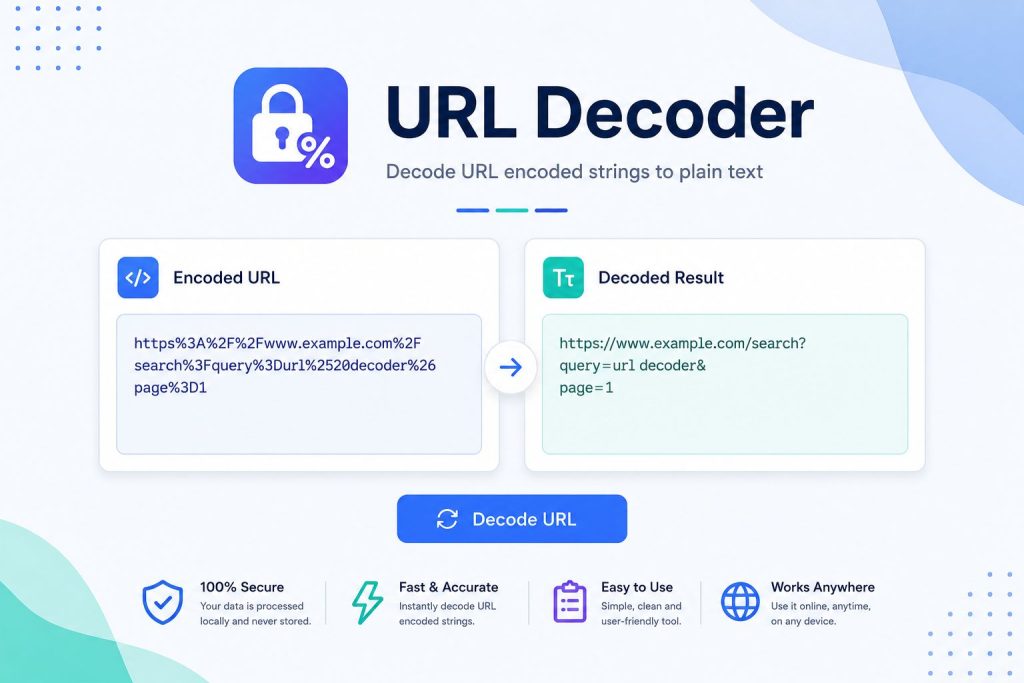
Have you ever clicked a link and landed on a broken page? Or opened a URL in your browser and seen a messy string of symbols like %2F, %20, or %3A staring back at you? You’re not alone. Millions of people run into this problem every single day, and most of them have no idea what those symbols mean or how to fix them.
That’s exactly where the URL decoder SpellMistake tool comes in. Whether you’re a developer, a blogger, an SEO professional, or just someone who accidentally ended up with a garbled link, understanding what a URL decoder does and how SpellMistake makes it effortless is the kind of knowledge that saves you real time and real headaches.
This guide covers everything you need to know. What URL encoding is, why it happens, what a URL decoder spellmistake actually means, and how to decode your URLs quickly and correctly every time.
Table of Contents
ToggleWhat Is URL Encoding and Why Does It Happen
Before you can understand a URL decoder, it helps to know why URLs get encoded in the first place.
A URL can only contain a limited set of characters. Letters, numbers, and a small group of special symbols like hyphens and underscores are safe to use. But spaces, ampersands, hash symbols, and accented letters? Those can break things.
When a browser or server encounters a character that is not allowed inside a URL, it converts that character into a percent sign followed by a two-digit hexadecimal code. This process is called percent encoding or URL encoding.
For example, a space becomes %20. An ampersand becomes %26. The at sign becomes %40. These encoded characters look strange to human eyes, but browsers and servers read them perfectly.
The reason this matters is simple. If characters like spaces or symbols were left as-is inside a URL, the server would get confused. It might read a space as the end of a URL, or treat an ampersand as a separator between query parameters when it’s actually part of a data value. Encoding keeps everything clean and interpretable.
What Does URL Decoder SpellMistake Mean
The phrase “URL decoder spellmistake” carries a double meaning, and both parts are useful to understand.
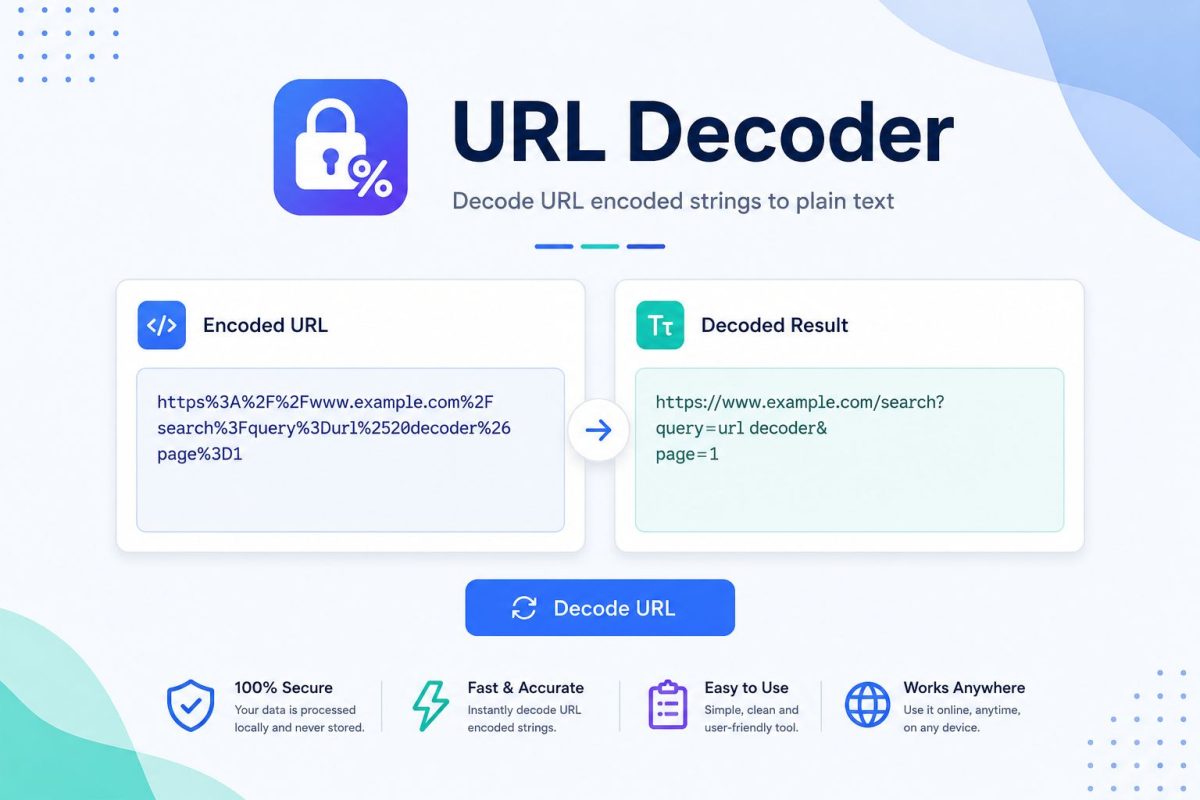
On one hand, SpellMistake is the name of a free online toolset available at spellmistake.com and spellmistake.info. It offers a URL encoder and decoder tool that lets you paste any encoded URL and instantly convert it back into readable, plain text. No sign-up, no downloads, and no cost involved.
On the other hand, a URL decoder spellmistake also refers to the errors that occur when URLs are encoded or decoded incorrectly. These logical mistakes in URL processing can break links, produce 404 errors, and cause serious problems for websites SEO performance, and user experience.
So when people search for “URL decoder spellmistake,” they may be looking for the SpellMistake decoding tool itself, or they may be trying to understand what went wrong with a URL and how to fix it. This guide addresses both.
Common URL Decoder Spellmistake Errors You Should Know
Understanding the most frequent encoding mistakes helps you catch them before they cause damage. Here are the URL decoder spellmistake errors that come up most often.
Double Encoding: The Silent Link Killer
Double encoding happens when a URL is encoded twice by accident. Instead of a space appearing as %20, it ends up as %2520. The percent sign from the first encoding round gets encoded again in the second round.
This is one of the hardest errors to spot by eye because the URL still looks plausible. But when a server tries to process it, the link breaks entirely. Double encoding is a common cause of unexpected 404 errors and redirect failures.
Mixing %20 and + for Spaces
Spaces in URLs can be represented two ways. In standard URL encoding, a space becomes %20. In form data encoding (used when a browser submits a form), a space becomes a + symbol.
Using these two methods interchangeably in the wrong context causes query strings to fail. A plus sign that was meant to represent a space might get read as a literal + character instead, changing the meaning of the parameter completely.
Using the Wrong Hexadecimal Value
A space is %20. But what if someone types %2O by accident, using the letter O instead of the number zero? The server cannot convert that back to a space. The link fails, often with a 400 or 404 error, and the mistake is nearly invisible to the human eye.
This kind of typo is exactly the type of error the URL decoder SpellMistake tool catches instantly. Paste the URL in, decode it, and you will see precisely where the problem lives.
Encoding Characters That Do Not Need Encoding
Not every character needs to be encoded. Letters, digits, and unreserved characters like hyphens and underscores are safe in URLs by default. Encoding them unnecessarily does not break the URL, but it adds clutter and can sometimes confuse parsing tools.
Keeping URLs clean and only encoding what needs encoding is both a good technical habit and an SEO best practice.
Incomplete or Truncated Encoding
Sometimes a special character starts to get encoded but the process is interrupted. The result is a partial percent sequence like a lone % with no hexadecimal digits after it. That single character can cause the entire URL to become invalid.
How to Use the SpellMistake URL Decoder Tool
If you have a URL full of encoded characters and you need to read what it actually says, the SpellMistake URL decoder makes the process straightforward. Here is how to use it.
- Open your browser and go to spellmistake.info or spellmistake.com and find the URL Encoder and Decoder tool.
- Locate the input field on the tool page.
- Paste your encoded URL into the input box.
- Click the Decode button.
- Read the plain-text output in the result field.
- Copy the decoded URL and use it however you need.
The result appears instantly. There is no waiting, no account creation, and no cost. If your URL was encoded twice (double-encoded), you may need to run it through the decoder a second time to get back to the original string.
The SpellMistake tool also works in reverse. If you need to encode a URL before using it in a link, API call, or email, you can paste plain text and click Encode. The tool handles both functions from a single, clean interface.
How URL Decoder SpellMistake Issues Affect Your SEO
A broken or poorly encoded URL is not just a technical annoyance. It has real consequences for your website’s performance in search results. Here is what happens when URL decoder spellmistake issues go uncorrected.
Search Engines Cannot Crawl the Page
When a URL contains invalid encoding, Google’s crawler may fail to reach the page at all. That means the content on that page goes unindexed, invisible to anyone searching for it. All the effort put into writing and optimizing that content gets wasted.
Duplicate Content From Encoding Variations
Imagine the same page being accessible at three different URLs because a space has been encoded as %20, as +, or left as a literal space in different parts of your site. Search engines may treat these as three separate pages and divide the ranking signals between them. This dilutes what SEO professionals call link equity.
Broken Links and 404 Errors
A URL decoder spellmistake that results in a broken URL creates a 404 error for any user who clicks it. Higher 404 rates increase bounce rates, lower time on site, and signal to search engines that something is wrong with your site.
Damaged UTM Parameters and Analytics
Marketers rely on UTM parameters added to URLs to track campaign performance. When those parameters contain encoding errors, the data they’re supposed to collect gets lost or scrambled. You end up making decisions based on inaccurate analytics without knowing why the numbers look off.
Who Uses a URL Decoder SpellMistake Tool
This kind of tool is genuinely useful for a wide range of people, not just software developers.
Web developers use it when debugging API responses, checking redirect chains, or inspecting URLs generated by their applications. Encoded strings are everywhere in back-end development, and being able to read them instantly makes troubleshooting much faster.
SEO professionals use URL decoders during technical audits. When running a crawl with tools like Screaming Frog or Ahrefs, they often encounter encoded URLs in the data. Decoding these helps identify patterns, check URL cleanliness, and fix structural problems before they affect rankings.
Digital marketers use decoders to inspect tracking links, UTM parameters, and affiliate URLs. A quick decode tells you exactly where a link is going and whether the parameters are intact and readable.
Bloggers and content creators use them when they come across a shared link that looks garbled. If someone sent you a URL and it looks like a mess of symbols, pasting it into a decoder gives you the clean version immediately.
Students and learners studying web development use URL decoders as a practical way to understand how browsers and servers communicate. Seeing the raw encoded form next to the decoded plain-text output makes the concept click in a way that reading about it alone does not.
Tips to Avoid URL Decoder SpellMistake Errors in the Future
Fixing a broken URL is important, but preventing the problem in the first place is better. Here are a few practical habits that keep your URLs clean.
Use a trusted tool for encoding and decoding. Manual encoding is error-prone. The SpellMistake URL encoder and decoder processes your input accurately and removes the risk of human typos in hexadecimal values.
Encode only what needs encoding. Do not encode the structural parts of a URL such as the protocol (https://), slashes, or query separators like ? and &. Encode only the values inside your parameters.
Test every link before publishing. Paste the finished URL into a browser or run it through a decoder before it goes live on your site. This catches errors before any user or search engine bot encounters them.
Run regular SEO audits. Tools like Google Search Console, Screaming Frog, and Ahrefs can identify broken links and crawl errors across your site. Checking regularly means URL decoder spellmistake errors get caught early rather than quietly hurting your rankings for months.
Understand the difference between UTF-8 and other encoding formats. UTF-8 is the standard on modern websites. Using a different encoding type can cause characters to display incorrectly or generate errors when the URL is processed. Sticking to UTF-8 ensures compatibility across all browsers and systems.
Be careful when copying URLs from email clients or word processors. These applications sometimes add invisible characters or change the formatting of a URL. Always paste a URL into a plain text editor first to strip any hidden formatting before using it.
More Information: 5ivemagazine