You pour a glass of water into an ice tray an hour before guests arrive, check the freezer, and find a tray of cold liquid. Or you tuck a water bottle into the freezer “for a minute” and forget it until you hear a crack.
Freezing time is one of those everyday questions with no single answer, because it depends on how much water you have, what holds it, and how cold the air around it really is.
This guide gives you realistic time ranges for the situations people actually ask about, explains why those times vary so much, busts a couple of popular myths, and shares practical ways to freeze water faster without ruining your containers.
Table of Contents
ToggleThe Short Answer: How Long Does Water Take to Freeze?
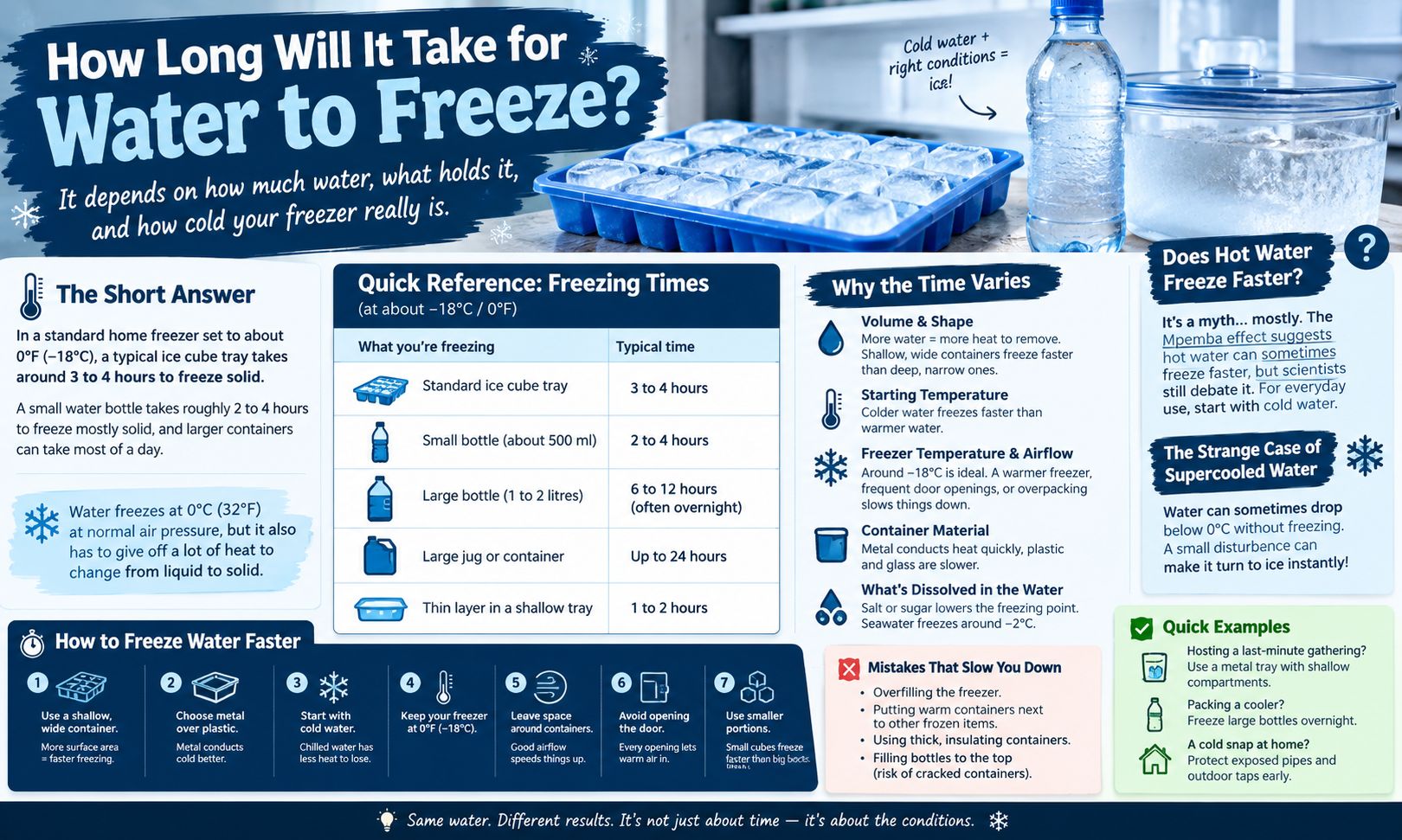
In a standard home freezer set to about 0°F (−18°C), a small amount of water, like a typical ice cube tray, usually takes around 3 to 4 hours to freeze solid. A small water bottle takes roughly 2 to 4 hours to freeze mostly solid, and larger containers can take most of a day.
Water freezes at 0°C (32°F) at normal air pressure. But reaching that temperature is only half the job. Water also has to give off a lot of heat to change from liquid to solid, which is why freezing takes longer than simply getting cold.
Quick reference table (approximate times in a freezer at about −18°C)
| What you’re freezing | Typical time |
| Standard ice cube tray | About 3 to 4 hours |
| Small bottle (about 500 ml) | About 2 to 4 hours |
| Large bottle (1 to 2 litres) | About 6 to 12 hours, often overnight |
| Large jug or container | Up to 24 hours |
| Thin layer of water in a shallow tray | About 1 to 2 hours |
These are rough guides, not guarantees. Your own freezer, how full it is, and the container material can easily shift each number.
Why the Answer Changes So Much
If you have ever wondered why one batch of ice takes three hours and the next takes six, here are the main causes.
Volume and Shape
More water means more heat to remove. A deep, narrow container also freezes slowly from the outside in, because the center is insulated by the ice forming around it. A shallow, wide container exposes more surface to cold air, so it freezes faster.
The Starting Temperature
Water straight from the tap is warmer than water from the fridge. Starting colder generally means less time to reach the freezing point. In an ordinary kitchen, cold water will normally freeze before warm water does.
Freezer Temperature and Airflow
The setting matters. At 0°F (−18°C), your freezer is cold enough for steady freezing. If the temperature drifts higher, or the door opens often, freezing slows noticeably. Overpacking can block airflow, which also adds time.
The Container Material
Metal conducts heat quickly, so a metal tray usually freezes water faster than plastic or silicone. Glass is slower and carries a risk of cracking, which we will cover below.
What Is Dissolved in the Water
Pure water freezes at 0°C. Water with salt or sugar freezes at a lower temperature. Seawater, for example, freezes at roughly −2°C because of its salt content. That is why salted roads stay clear of ice at temperatures that would freeze plain puddles.
How Long Does Water Take to Freeze in Different Situations?
Let’s go through the scenarios people search for most.
In the Freezer
This is the baseline case. Ice cubes in a standard tray usually take about three to four hours, and some trays need closer to six if the freezer is crowded or warm. Water frozen in a large block, like a pitcher or a big container, takes much longer because the heat has to move through a thicker mass.
In a Water Bottle
A typical single-serve bottle often freezes in two to four hours, but not always evenly. The outside freezes first, leaving a liquid core for a while. Large bottles, particularly those used for camping or lunch boxes, may need to sit overnight.
One safety point matters here. Water expands when it freezes, by roughly nine percent. If you fill a bottle to the top, the expanding ice can crack it. Leave some empty space at the top.
In the Fridge
It will not freeze. A fridge typically sits around 3 to 4°C (37 to 40°F), which is above freezing. If something in your fridge is freezing, the temperature is probably set too low.
Outside in Winter
Outdoor freezing depends on weather, not a thermostat. A shallow puddle in still air at several degrees below zero can freeze within hours, while a larger pond may take days of consistently sub-zero temperatures. Wind, sunlight, and the size of the water body all change the result.
If you are thinking about walking on a frozen pond, a commonly cited safety guideline is at least four inches (about 10 cm) of clear ice, but conditions vary, so follow local guidance rather than guessing.
In Pipes and Outdoor Taps
Moving water and pipes inside a heated home are slower to freeze than a puddle. Exposed pipes in unheated spaces are at greater risk during long periods below freezing. Insulating pipes and letting a tap drip during a hard freeze are common ways to reduce the chance of burst pipes.
Does Hot Water Freeze Faster Than Cold Water?
You have probably heard that hot water freezes faster than cold. This claim is known as the Mpemba effect, named after a Tanzanian student who noticed it in the 1960s.
The honest answer is that it is contested. Some experiments report that hotter water sometimes freezes first, and others fail to reproduce it. Possible explanations include evaporation, dissolved gases, and the way convection currents form, but scientists have not settled on a single clear cause.
For everyday kitchen use, treat it as a curiosity, not a trick. Starting with cold water is a safer bet if you want ice sooner.
The Strange Case of Supercooled Water
Here is one of the more fascinating things about freezing. Pure water can sometimes drop below 0°C without turning to ice.
This is called supercooling. It happens when water is very still and has few impurities, so it lacks a starting point, called a nucleation site, for ice crystals to form. If you disturb the bottle, or tap it, the water can suddenly turn to slush in seconds.
That is why some people pull a bottle from the freezer that looks fully liquid but freezes the moment they open it. It is a harmless party trick, but it also explains why freezing times can feel unpredictable.
How to Freeze Water Faster
If you need ice quickly, a few small changes make a real difference.
- Use a shallow, wide container. More surface area means faster heat loss.
- Choose metal over plastic. Metal trays conduct cold more efficiently.
- Start with cold water. Chilled water has less heat to lose.
- Check your freezer temperature. Aim for around 0°F (−18°C).
- Leave space around containers. Good airflow speeds freezing.
- Avoid opening the door. Every opening lets warm air in.
- Use smaller portions. Small cubes freeze faster than big blocks.
Mistakes That Slow You Down
- Overfilling the freezer so air cannot circulate.
- Putting warm or hot containers directly next to other frozen items, which can raise the temperature nearby.
- Using thick, insulating containers, like some heavy glassware.
- Filling bottles to the top, which risks cracked containers.
Practical Examples You Can Picture
Hosting a last-minute gathering. You need ice in about two hours. Pour cold water into a metal tray with shallow compartments rather than a deep plastic one. You will likely get usable ice faster.
Packing a cooler. Freeze large bottles the night before. They stay frozen longer than loose cubes and double as drinking water as they melt.
A cold snap at home. If outdoor temperatures drop well below freezing, protect exposed pipes and outdoor taps well before the freeze starts, not after.
If you enjoy this kind of everyday science, you may like more of our simple, practical explainers covering how common things actually work.
Frequently Asked Questions
How long does it take water to freeze in the freezer?
A typical ice cube tray takes about three to four hours at around 0°F (−18°C). Larger containers and bottles take longer, often six to twelve hours or overnight.
Does hot water freeze faster than cold water?
Usually, no. Cold water normally freezes first. A phenomenon called the Mpemba effect suggests hot water can sometimes freeze faster, but scientists still debate whether it is reliable.
Can water freeze in the fridge?
No, not under normal settings. A fridge runs at about 3 to 4°C, which is above water’s freezing point. If water freezes there, the temperature is set too low.
What temperature does water freeze at?
Pure water freezes at 0°C (32°F) at standard pressure. Salty or sugary water freezes at lower temperatures.
Why is my water bottle liquid in the freezer but turns to ice when I open it?
That is supercooling. Very still, pure water can go below freezing without forming ice, and a bump or disturbance triggers sudden freezing.